
This Journalist Was The First To Predict Where The Kremlin's Policies Would Lead
2- 6.10.2026, 18:12
- 1,908
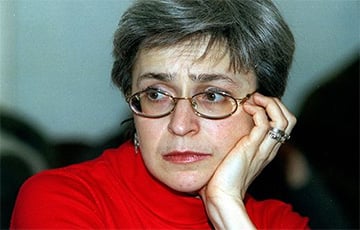
Twenty years ago, Putin's regime killed Anna Politkovskaya for speaking the truth.
She was the first to predict where the Kremlin’s policies would lead.
Twenty years ago, Russian journalist Anna Politkovskaya was murdered; for many years, she had warned about the consequences of Putin’s policies. Her investigations into the war in Chechnya now read like a prophecy of what Russia would later bring to Ukraine, writes the French newspaper Le Monde (translation — Charter97.org website).
Politkovskaya was murdered on October 7, 2006—Vladimir Putin’s birthday. She was shot in an elevator in her Moscow apartment building. The journalist was 48 years old.
At the editorial office of *Novaya Gazeta*, where she had worked since 1998, her workspace has been turned into a memorial. Her glasses, voice recorder, and bag still sit on her desk. Next to them is a copy of the Russian Criminal Code with her annotations.
The editor-in-chief of *Novaya Gazeta*, Dmitry Muratov, believes that Russian security agencies were behind the murder.
“The authorities are involved in this murder,” he stated.
During her seven years at *Novaya Gazeta*, Politkovskaya wrote 751 articles, more than half of which were devoted to Chechnya. She reported in detail on torture, abductions, rapes, looting, and mass killings of civilians.
Today, these accounts sound particularly terrifying. Many of the methods used by the Russian army that she described have since reappeared in Ukraine—from filtration camps and torture to the destruction of cities and mass graves.
Politkovskaya did not limit herself to journalistic work. During the hostage crisis at the Dubrovka Theater in Moscow in 2002, the authorities brought her in to help with negotiations. Two years later, she tried to get to Beslan during the school siege, but was poisoned on the way and was unable to reach the scene.
She was also one of the first to write in detail about Ramzan Kadyrov. In 2004, the journalist met with him in Chechnya. Kadyrov called her an enemy and compared her to Shamil Basayev.
Politkovskaya made no secret of her views on Putin. She accused him of destroying Russian democracy, strengthening the power of the security services, and using war to consolidate his own regime.
As early as the beginning of the 2000s, she warned about the formation of Putin’s “vertical of power.”
“Today we are surrounded by Putin’s friends and his people,” the journalist wrote.
According to Politkovskaya’s acquaintances, she was obsessed with the pursuit of justice and viewed journalism as a way to truly help people. She gathered information bit by bit, cross-checked evidence, and was not afraid to ask uncomfortable questions—even of those who wielded immense power.
Her investigations made Politkovskaya one of the most famous Russian journalists abroad and, at the same time, one of the most dangerous figures for the Kremlin.
Several perpetrators and accomplices were convicted of Politkovskaya’s murder, but the mastermind behind the crime was never identified. In 2023, Putin pardoned one of those convicted of the journalist’s murder after he had participated in the war against Ukraine.
Politkovskaya’s story is perceived differently today than it was 20 years ago. What she warned about became a reality, first in Russia and then in Ukraine. And that is precisely why her journalism once again sounds like a warning that people have been unwilling to hear for far too long.

Bank's name: Bank Millennium S.A.
Address: ul. Stanislawa Zaryna, 2A, 02-593, Warszawa
IBAN: PL97116022020000000216711123
SWIFT: BIGBPLPW
Name of the account holder: Fundacja “KARTA ‘97”
Purpose/title of payment: Donation for statuary aims
You can contact us by the e-mail charter97@gmail.com