

Sasha Gets Three Percent In Subsidies
1- 28.11.2026, 12:52
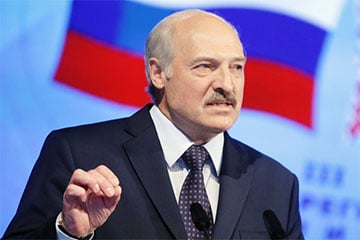
How much does Russia give Lukashenko for his living expenses?
Last week, all state-run Belarusian media outlets took offense at European Commission President Ursula von der Leyen for comparing the GDPs of Poland and Belarus. Grigory Azarenok compared Belarus to a hardworking woman and Poland to a woman of easy virtue. He would have been better off not doing that.
A COUNTRY ON WELFARE
The President of the European Commission said that Poland’s per capita GDP is three times higher than Belarus’s gross domestic product, even though the two countries were on an equal footing in the early 1990s. Belarusian propaganda took offense.
“By the way, how is Ursula’s health? As for her logic—it’s clear. She lacks it. Her education is lacking, too,” said propagandist Lyudmila Gladkaya.
The arguments of the other propagandists were roughly the same. State media claimed that gross domestic product should be calculated based on purchasing power parity. But they didn’t mention that GDP based on purchasing power parity in Poland is still 1.7 times higher.
They brought up communal apartments. But they didn’t mention that the difference in utility costs is factored into GDP calculated using purchasing power parity.
And of course, they asked the same rhetorical question: “Have you seen Poland’s national debt?”
But Grigory Azarenko’s metaphor turned out to be the most vivid. He compared Belarus to an honest, hardworking woman, and Poland to a woman of questionable moral character—one with, as they say, a low level of social responsibility. Well, because, as he explained, Belarus lives on its own resources, while Poland lives on European Union money.
HOW MUCH DO THEY PAY
But one has to be more careful with metaphors. Indeed, Poland is the largest recipient of European loans and subsidies. Over the past 25 years, these loans, subsidies, and grants have totaled approximately 12 billion euros. Poland itself has contributed about one billion euros to the European Union budget.
At the same time, Poland’s GDP last year was 920 billion euros. In other words, European support accounts for just over one percent of the Polish economy.
Belarus’s GDP last year was $90 billion. Belarus received $1.2 billion in loans from Russia. An additional 1.7 billion came in the form of grant aid to the Belarusian budget from the Russian Ministry of Finance. This, incidentally, accounts for 17 percent of all revenue in the Belarusian budget.
In other words, direct Russian aid in 2025 (amounted to about 3 percent of Belarus’s GDP https://charter97.org/ru/news/2020/6/1/380847/). This share is already more than twice as large as the share of European aid to Poland.
But that’s not all. Because there are also hidden energy subsidies—that is, preferential prices for oil and gas. If we add those in as well, then—depending on the calculation method—Russian aid to Belarus last year amounted to between 6 and 8 percent of Belarusian GDP. That is five to six times more than in Poland.
So, if Azarenok compares Poland to a woman of easy virtue, then who should the Belarusian authorities be compared to?
WHAT ARE THEY SPENDING IT ON
But aside from the question of who is paid more, there is also the question of how effectively that money is being used. Poland’s GDP grew by twenty and a half percent from 21 to 25. Belarus’s GDP grew by seven and a half percent over the same period. The Polish economy grew by an average of 4 percent per year, while the Belarusian economy grew by one and a half percent. Labor productivity in Poland is two and a half times higher than in Belarus.
This is because Poland used European loans to improve the efficiency of its economy. Russian subsidies to Belarus were used to maintain the current profitability of enterprises, raise wages, and plug holes in the budget.
As Andrei Egorov , First Deputy Chairman of the National Bank of Belarus , rightly said:
“As long as money is put to work in real production and creates new products, debt pulls the economy upward. Problems begin the very moment loans are taken not for development, but to live off”
So if we take this metaphor to its logical conclusion, it turns out that the Belarusian authorities are behaving not just like a woman of easy virtue. They’re behaving like a very foolish woman of easy virtue. One who doesn’t think about the future at all. And, instead of investing her clients’ money in her own development, she spends it on alcohol and drugs.
Alexei Mazartov, “Belarusians and the Market”

Bank's name: Bank Millennium S.A.
Address: ul. Stanislawa Zaryna, 2A, 02-593, Warszawa
IBAN: PL97116022020000000216711123
SWIFT: BIGBPLPW
Name of the account holder: Fundacja “KARTA ‘97”
Purpose/title of payment: Donation for statuary aims
You can contact us by the e-mail charter97@gmail.com