

WSJ: Ukrainian Drones Have Reached Siberia
1- 10.07.2026, 9:47
- 2,666
For Putin, this could be the last straw.
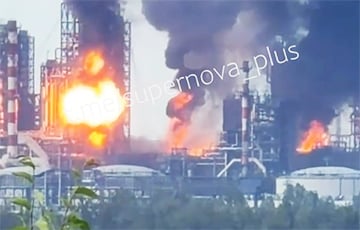
On Monday, Ukrainian drones attacked Russia's largest oil refinery, located in Omsk, Siberia. According to The Wall Street Journal, this strike demonstrated that Ukraine has significantly expanded the range of its long-range operations.
The publication notes that air defense systems in the area of the Omsk oil refinery were underdeveloped, as Russian authorities considered the facility too far from Ukraine to be a potential target.
Until recently, Ukrainian strikes on Russian territory were limited to the European part of the country, located approximately 1,600 kilometers from territory controlled by Kyiv. However, Omsk is located nearly 2,400 kilometers away as the crow flies. According to estimates by Fire Point, the range of the drones used in this operation reaches 3,400 kilometers.
According to The Wall Street Journal, this means that vast areas of Russia are now under threat, including major oil and gas facilities in Western Siberia and hundreds of strategically important military sites. At the same time, Russia’s air defense system is already under severe strain due to regular attacks by Ukrainian missiles and drones.
Since the beginning of the year, all major oil refineries in the European part of Russia have been targeted. As a result, gasoline production has fallen by at least a quarter, leading to fuel shortages, lines at gas stations, and the imposition of restrictions in several regions. In addition, a shortage of diesel fuel is beginning to be felt across the country, prompting Moscow to announce a ban on its export.
“In a sense, the strike on Omsk could very well be the last straw. This is a truly serious signal, and the farther Ukraine is able to strike, the more problems the Russian energy system faces,” said James Henderson , an expert at the Oxford Institute for Energy Studies .
Alongside strikes on distant targets, Ukraine continues to attack targets in the occupied territories of the country’s south and in Crimea, located at distances ranging from 80 to 240 kilometers.
According to former Royal Air Force Air Marshal Edward Stringer, Russia has effectively lost both its operational and strategic depth of defense.
“The number of air defense assets is limited, and it is impossible to simultaneously cover the front line and the entire territory of the country. The more targets there are to defend—effectively all the way to Vladivostok—the more vulnerable the defense becomes, and the easier it is for Ukraine to strike targets in the Russian rear,” he noted.
According to The Wall Street Journal, the range of Ukrainian drones now includes the liquefied natural gas export terminal in Yamal, the largest oil and gas fields in Western Siberia, pipeline infrastructure, and a number of key enterprises in Russia’s defense-industrial complex.
Economists believe that the oil refining industry remains one of the weakest links in the Russian economy. Because the domestic market depends on cheap fuel, the government has to increase subsidies for agriculture, airlines, and other sectors, while export revenues are declining.
Russian energy expert Mikhail Krutikhin believes that the fuel shortage could affect not only the civilian sector but also military supplies, and could lead to disruptions in the delivery of food and other goods.
Ukrainian and Western officials hope that mounting pressure on the Russian economy may eventually force Vladimir Putin to end the war.
According to the Financial Times, about 50 million Russians—roughly 35% of the country’s population—are already feeling the effects of the fuel crisis. Analysts estimate that between 20% and 40% of oil refining capacity has been taken offline.
Against this backdrop, Russia has sharply increased its gasoline imports from Belarus. In June, shipments reached a record 141,000 metric tons. Although this volume falls significantly short of daily domestic consumption, it was 141 times higher than a year ago.

Bank's name: Bank Millennium S.A.
Address: ul. Stanislawa Zaryna, 2A, 02-593, Warszawa
IBAN: PL97116022020000000216711123
SWIFT: BIGBPLPW
Name of the account holder: Fundacja “KARTA ‘97”
Purpose/title of payment: Donation for statuary aims
You can contact us by the e-mail charter97@gmail.com