


Lukashenko Let Slip About The Problem
9- 12.07.2026, 14:38
- 5,648
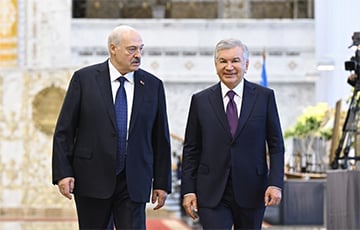
Of course, the dictator was wrong to bring up the Pakistanis.
The 150,000 Pakistanis promised a year ago never made it to Belarus. But Lukashenko hasn’t lost hope and believes that the problem of the shortage of workers in Belarus can be solved even without Belarusians. He has decided to look for the workers he needs in Uzbekistan, writes planbmedia.io.
“We love Uzbeks here. More than Pakistanis… “I want your people to come here with their families,” Lukashenko said at a meeting with Uzbekistan’s President Shavkat Mirziyoyev.
Of course, Lukashenko’s mention of the Pakistanis was unnecessary. The 150,000 Pakistanis promised to them have been waiting in Belarus for over a year now. Because it turned out that, aside from Belarus’s great and pure love, there is nothing else to offer to mass labor migrants.
That is why labor migration to Belarus is, to put it mildly, not very widespread. According to the Department of Citizenship and Migration, there were only 32,000 labor migrants in the country at the end of 2025. So Lukashenko didn’t skimp on promises.
“Free education, healthcare—it’s all free, just like for our Belarusians under equal conditions. In the city, you just have to wait a little while, and you’ll get housing—that’s it. We need people, and preferably from Uzbekistan. They’re very good people,” he enthused.
And there was a reason for it. Because, unlike Belarus, Uzbekistan has a large population. This country is the most densely populated state in Central Asia. Over the past thirty years, its population has grown from 21 to nearly 38 million people. So President Mirziyoyev wasn’t opposed, in principle, to sharing.
“They even provide housing,” he chimed in.
So far, however, workers from Uzbekistan aren’t exactly flocking to Belarus for free housing. Although Uzbeks are one of the largest groups of migrant workers, their total number in the country is not impressive. As of the end of 2025, only 3,600 Uzbek citizens were working in Belarus. This is clearly not enough to replace the 600,000 Belarusians who have left the country.
Moreover, in order to lure migrant workers, the Belarusian authorities are willing to promise them things that Belarusians themselves do not have. As the governor of the Grodno Region, Yuri Karaev, boasted, foreign workers at local agricultural enterprises earn between 2,500 and 3,000 rubles. The average salary of an ordinary Belarusian agricultural worker ranges from 1,500 to 1,800 rubles.
“Today we agreed that Uzbekistan (Uzbek investors) would come to, say, the Vitebsk Region and acquire plots of land,” Lukashenko promised.
The Belarusian authorities do not distribute Belarusian land so generously to Belarusian farmers. That’s because Belarusians are nothing but a constant source of trouble for the Belarusian authorities. They don’t want to work 12-hour days; instead, they want something strange. And the authorities would have replaced the Belarusians with someone else long ago, but they just can’t find anyone willing to take their place.

Bank's name: Bank Millennium S.A.
Address: ul. Stanislawa Zaryna, 2A, 02-593, Warszawa
IBAN: PL97116022020000000216711123
SWIFT: BIGBPLPW
Name of the account holder: Fundacja “KARTA ‘97”
Purpose/title of payment: Donation for statuary aims
You can contact us by the e-mail charter97@gmail.com