A Plane Carrying Taliban Members In Minsk: What Is Lukashenko Hiding?
6- 20.08.2026, 9:55
- 4,358
The propaganda is keeping the details of the visit under wraps.
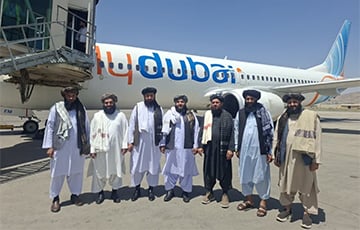
A 13-member delegation from Afghanistan visited Belarus. Official sources state that the Taliban arrived at Minsk’s invitation to participate in the work of the Joint Commission on Economic and Trade Cooperation between the two countries.
As a reminder, the previous meeting in Minsk took place in February 2026. At that time, the Ministry of Foreign Affairs held talks with representatives of the Afghanistan National Development Corporation on “intensifying contacts,” and international media noted that the Lukashenko regime sees nothing wrong with engaging in dialogue with the “Taliban.”
This time, the delegation was led by the Minister of Agriculture, Irrigation, and Livestock Mawlavi Ataullah Omari. The delegation also included representatives of the Afghan government, state-owned companies, and the ministries of transportation and civil aviation, finance, foreign affairs, and trade.
How does the Lukashenko regime see the benefits of these relations for itself, is the Belarusian government not afraid of their toxicity, and what might Afghanistan need from our country?
According to historian and political scientist Roza Turarbekova, the Belarusian authorities are not particularly concerned about their reputation:
“It’s hard to ruin an image you don’t have,” the expert noted on “Euro Radio”. — But here, first of all, I would like to distinguish the Taliban and their regime from the Afghan people. Just as we distinguish Belarusians from the Lukashenko regime.
Today, Afghanistan is facing extremely difficult conditions. Because of international isolation, because no one wants to deal with them, and, of course, because of the internal situation—they’re effectively facing a humanitarian catastrophe.
It is difficult for the Taliban to govern the country; moreover, they have banned half the population—women—from working, based on a radical Islamist doctrine, and they face the problem of illiteracy, which is why they need foreign specialists.
And on the diplomatic front, they are forced to fight, if not for recognition, then at least to establish some kind of working relationship. They’ll worm their way in wherever they can.
The number one shift in this regard—and not a very positive one—is with Russia, where the Taliban are no longer recognized as a terrorist organization and where Russia is even engaging in military-technical cooperation with them. The Taliban have established decent working relations with China, which is participating in the development of a number of important mineral deposits.
At the same time, there are major concerns regarding infrastructure projects and their development. This is because the Taliban is recognized as a terrorist organization by a number of the world’s leading nations, including the United States. Although the Taliban recently approached Donald Trump with a proposal to return to Afghanistan—as I understand it, this involves technical assistance.
They were even received in Brussels recently, although this sparked a scandal and heated debates in the European Parliament, and some MEPs apologized to Afghan women.
So what did the Taliban need in Minsk? First, says Roza Turarbekova, it’s one of the few places where they’re always welcomed. Second, they are not only welcomed but have never been recognized as a terrorist organization (Lukashenko pointed this out as early as 2021, following the Taliban’s rapid rise to power).
But even before that, the expert notes, relations between the two countries began to develop with the active involvement of Uzbekistan:
— I know for a fact that the Uzbeks provided their infrastructure, and a certain amount of Belarusian goods made their way into Afghanistan before 2021. So they’re familiar with our goods—and they’d like to continue receiving them. That’s why a large delegation led by the Minister of Agriculture has arrived. But, interestingly, it also included deputy heads of all key ministries, including the Ministry of Foreign Affairs and the Ministry of Finance.
Today, as we know, Uzbekistan has once again established a presence in Belarus: migrant workers have arrived, Uzbek businesses are interested in the agricultural sector, and Uzbek trading houses have opened in Grodno and Minsk. Perhaps Afghans have followed in the Uzbeks’ footsteps.
But an even more interesting point, as Turarbekova noted, lies in the silence of the propaganda machine—neither the state news agency BELTA, nor the press service of the Council of Ministers, nor the Belarusian Ministry of Foreign Affairs reported on the meeting with the Afghan side. One might ask: Why the secrecy, if even Europe, for pragmatic reasons, is beginning a dialogue with such controversial groups that have come to power in Afghanistan? And that is the big question.

Bank's name: Bank Millennium S.A.
Address: ul. Stanislawa Zaryna, 2A, 02-593, Warszawa
IBAN: PL97116022020000000216711123
SWIFT: BIGBPLPW
Name of the account holder: Fundacja “KARTA ‘97”
Purpose/title of payment: Donation for statuary aims
You can contact us by the e-mail charter97@gmail.com