


Humanoids Made An Impression At The World Humanoid Robot Games In Beijing
1- 26.08.2026, 13:51
- 1,212
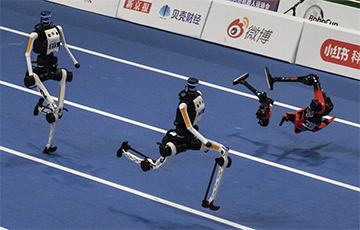
Robots have broken many human records.
The second World Humanoid Robot Games have concluded in Beijing, showcasing both the rapid progress of robotics and its current limitations. The robots have learned to run faster than last year’s competitors, surpassed human records in certain disciplines, and demonstrated impressive coordination. But when it comes to performing everyday tasks, they still lag significantly behind humans, writes ArsTechnica.
The races were the most spectacular moments of the competition. Some robots covered 100 meters faster than the time set by record-holder Usain Bolt. However, along with the records came numerous crashes. Several machines were unable to brake properly after crossing the finish line, crashing into barriers, breaking down, and even catching fire.
According to Dipam Patel, a computer science specialist at Purdue University, progress over the past year has indeed been significant. “There has definitely been a huge engineering breakthrough compared to what we saw last time,” he said.
However, these achievements do not mean that humanoids have already become all-purpose assistants. Most of the robots are optimized for specific competitions and pre-programmed scenarios. A robot capable of sprinting 100 meters is by no means necessarily capable of performing simple household chores.
That is precisely why the less spectacular events turned out to be the most revealing at the Games. The robots were tasked with washing and hanging laundry, folding clothes, cleaning rooms, carrying luggage at a hotel, arranging books, and performing small tasks with their hands. In the fire and rescue challenge, only three out of 12 teams were able to complete all the tasks.
Another problem is dependence on humans. In some events, participants were allowed to use remote control, although this resulted in a deduction from their final score. According to Patel, true autonomy requires robots to be able to independently handle a vast number of unforeseen situations.
“The robot needs to be trained for every possible non-standard scenario, and that’s practically impossible,” the researcher explained.
The Beijing Games revealed a mixed picture. Robots are rapidly improving at narrow, predefined tasks, but they still lack versatility. And the industry’s ultimate test will take place not in the sports arena, but in factories, warehouses, hotels, and ordinary homes.
Against the backdrop of billions in investment, it is precisely the ability to work safely and independently in the real world—rather than spectacular records and viral videos—that may become the key indicator of the maturity of humanoid robotics.

Bank's name: Bank Millennium S.A.
Address: ul. Stanislawa Zaryna, 2A, 02-593, Warszawa
IBAN: PL97116022020000000216711123
SWIFT: BIGBPLPW
Name of the account holder: Fundacja “KARTA ‘97”
Purpose/title of payment: Donation for statuary aims
You can contact us by the e-mail charter97@gmail.com