
TVP: Putin's Missiles Are Working Against Him
2- 27.08.2026, 10:29
- 1,810
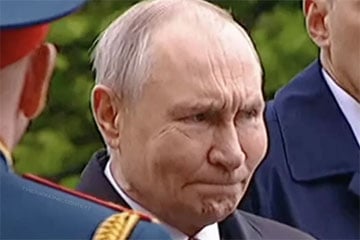
Ukrainians are taking a tougher stance on the issue of peace.
The intensification of Russian missile and air strikes on Ukraine may have the opposite effect of what the Kremlin expects: rather than forcing Kyiv to agree to territorial concessions, they are making Ukrainian society less willing to cede additional territory to Russia. This is stated in an analysis by TVP World.
As the publication explains, the shortage of Patriot-class interceptors is giving Russia increasing opportunities to launch ballistic missiles at Ukrainian cities. Russian dictator Vladimir Putin may be counting on the bombings to force Ukraine to make concessions.
However, as the author notes, the Russian attacks are not forcing Ukrainians to accept Moscow’s terms. On the contrary, resistance to territorial concessions is growing among Ukrainians.
The article notes that, according to a poll, an increasing number of Ukrainians believe that ceding territories in the Donbas would reward aggression and create conditions for a new war. Thus, the cost of accepting Moscow’s terms is rising alongside the pressure for peace advocated by Ukrainian President Volodymyr Zelenskyy.
A compromise that Putin called “exotic”
The authors noted that Zelenskyy recently proposed a peace plan calling for a ceasefire, a simultaneous withdrawal of troops from the Donbas to create a buffer zone and a free economic zone, as well as an agreement on the role of NATO and the European Union.
The second point is central to this plan. The previous U.S. proposal assumed that Russian troops would remain in their positions, while Ukraine would withdraw its forces, creating space for a possible Russian offensive. In the new plan, however, as Zelenskyy noted, Ukraine and Russia are taking “equal steps back,” and the zone between them will be under the control of “some third party.” Exactly which one has not yet been decided.
“This uncertainty means that no one will be clearly responsible for controlling the zone. At the same time, it allows negotiations to continue without immediately resolving all legal issues. The formal issue of sovereignty over the part of the Donetsk region controlled by Ukraine will be postponed, since the parties currently cannot reach an agreement on it,” the publication explained.
The author speculated that, in practice, Ukrainian troops will withdraw from their positions but will not hand them over to Russia. The fighting for Slavyansk, Kramatorsk, and the Ukrainian belt of fortified cities could come to an end.
As the article notes, the Kremlin’s negative reaction was immediate. Putin stated that any settlement must take into account “the realities on the ground” and called the proposals “exotic.” His press secretary, Dmitry Peskov, rejected the plan’s central mechanism.
By “realities on the ground,” Moscow likely means not only the territories currently occupied by its troops but also its claims to four Ukrainian regions as a whole—Donetsk, Luhansk, Zaporizhzhia, and Kherson—the publication suggested.
Missiles Are Making Ukrainians More Resolute
However, a poll by the Kyiv International Institute of Sociology, conducted in July and August of this year, showed that 60% of respondents reject the withdrawal of Ukrainian troops from the Ukrainian-controlled part of Donbas in exchange for security guarantees from the West. In April, that figure was 57%. In Kyiv itself, which has been subjected to intense shelling, the proportion of those opposed to such a move rose from 62% to 69%.
The same poll showed that 59% would agree to a ceasefire along the current front line without recognizing Russian sovereignty—in exchange for weapons and security guarantees. In Kyiv, support for this option reached 73%. Thus, many Ukrainians are willing to postpone the issue of liberating the occupied territories but do not want to agree to additional territorial concessions.
According to the author, it is precisely the Russian strikes that “narrow the political space for the concession Putin demands—the withdrawal of Ukrainian troops.” In his view, support for a ceasefire reflects a desire to put an end to the loss of life. But resistance to the withdrawal of troops reflects a fear that concessions will prompt Russia to launch a new attack.

Bank's name: Bank Millennium S.A.
Address: ul. Stanislawa Zaryna, 2A, 02-593, Warszawa
IBAN: PL97116022020000000216711123
SWIFT: BIGBPLPW
Name of the account holder: Fundacja “KARTA ‘97”
Purpose/title of payment: Donation for statuary aims
You can contact us by the e-mail charter97@gmail.com