
Dugin Is Starting To Slip Up
2- 29.08.2026, 21:05
- 3,558
This is worth noting.
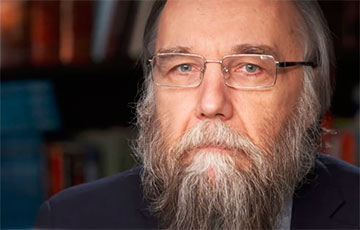
Russian oracle and ventriloquist Alexander Dugin said the following in recent “exclusive” interviews: Ukraine must be abolished, the West must be defeated, liberals are evil, and happiness lies in the family. But that’s what he always says. This time, however, there was something even more eccentric: we must decentralize megacities so as not to create easy targets and to increase the Russian birth rate.
But the most interesting thing is that Dugin, like his masters, is starting to slip up in his interviews (both of them). This is worth paying attention to.
Alexander Dugin is known for his conspiracies and incantations. The unsinkable dreadnought of the aggressor nation’s ideological fleet works diligently as a philosopher. That is, he pretends to live in a different dimension from everyone else—even the most patriotic and pro-war compatriots.
He captivates “good, simple Russian people” (not to be confused with “good Russians”) with his calculated otherworldliness. Of course, not in the same way that foreigners at the end of the last century bewitched the naive citizens of the USSR with chewing gum and flashy clothes. Dugin looks over the heads of his contemporaries into the future and sees conquered peaks there.
Such a cozy little corner
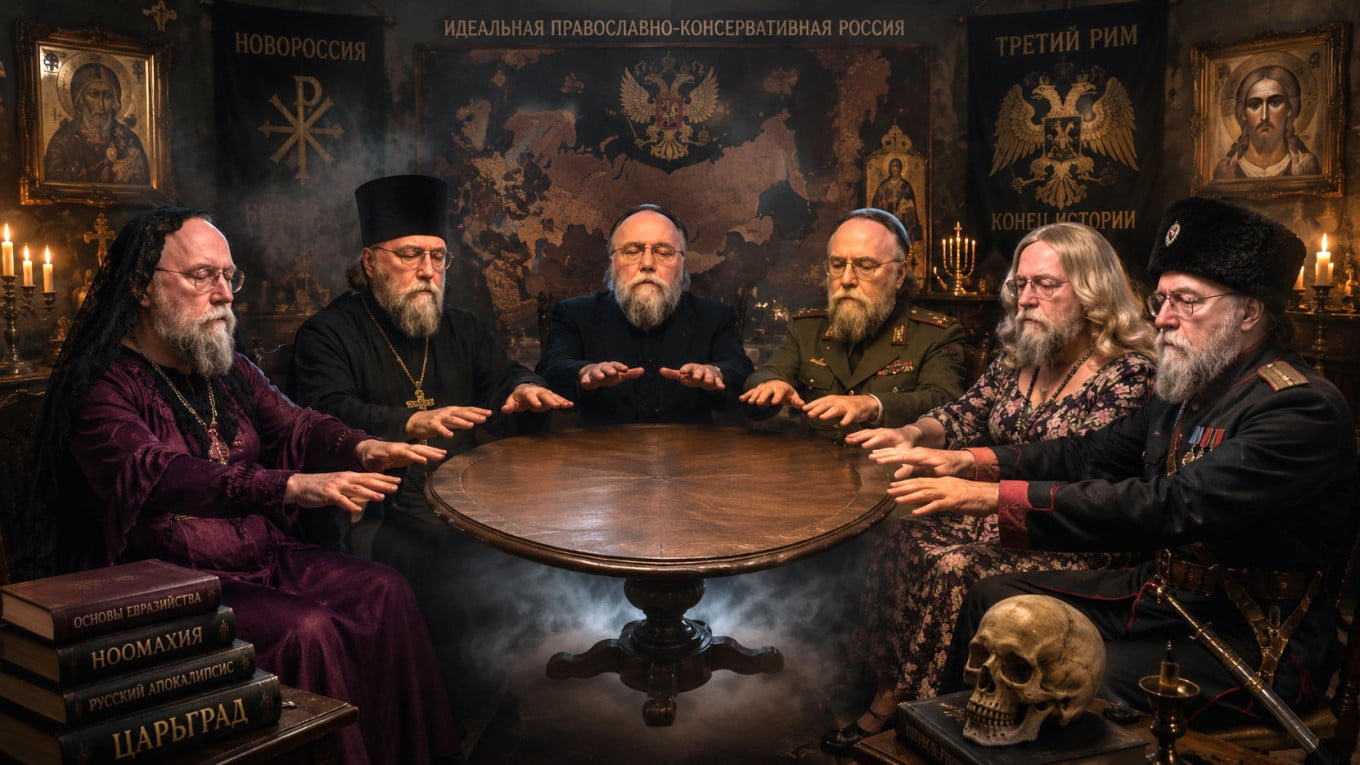
Anyone who has ever wondered about the origins of Dugin’s views and tactics knows where they came from. At a young age, he became close with members of the underground “Yuzhinsky Circle,” founded by the writer and thinker Yuri Mamleev in a room in a barracks that, until 1968, was located on Yuzhinsky Lane (renamed Bolshoy Palashevsky Lane again in 1993).
Dugin was also well acquainted with Mamleev and his gloomy “metaphysical” prose, as well as with the mystical poet close to him, scholar, and translator Evgeny Golovin, who had founded the “Black SS Order” as early as 1974, was renowned as a guru in Moscow rock ’n’ roll circles, and wrote songs and philological works. It was he who introduced Dugin to the ideas of the French conservative philosopher René Guénon, who cursed progress and liberal values, calling for enlightenment from the irrational East and “eternal wisdom,” which the vain West had betrayed, and whose days were therefore numbered.
In 1988, together with another member of the circle, the philosopher and dissident Geydar Dzhemal, the 24-year-old Dugin joined the “Memory” society, but they were expelled rather quickly for “ties to the émigré community,” which the patriotic anti-Semites feared. But in terms of his affinity for tradition, hatred of the West, and ideas about the occult foundation of the universe, Dugin remains close to any system of beliefs based on a sense of vulnerability to others, often imagined successes, a thirst for revenge, and a maniacal intolerance toward the Other.
The Other is, in general, anything that is not you and not your pain, not your traumas. By insisting that the West has taken over everything, shares nothing, and has abolished the multipolar world, Dugin does nothing but threaten to destroy all multipolarity and, indeed, any signs of diversity. The principle of autonomous existence, based on free will and the pursuit of freedom of choice, is the worst enemy of the order he has been trying to bring about ever since 1997, when—with the support of the General Staff of the Russian Army—the pilot edition of his *Fundamentals of Geopolitics* was published in 1997 with the support of the General Staff of the Russian Army. It is an openly fascist book that maps out the Russian Federation’s future military activities.
At the time, such views seemed completely marginal.
They were treated in the same way as the National Bolshevik Party founded by the writer Eduard Limonov. Alexander Dugin and Yegor Letov bolstered it with their participation, not to mention the strange—and for many, purely provocative—rapprochement with it by Sergei Kurekhin: the avant-garde musician received party membership card number 418—a mystical number in the teachings of Aleister Crowley, in which Dugin was deeply interested. Despite all its pretensions, the NBP was often referred to as an art project—if people weren’t just making fun of it. It was believed that “money would triumph over evil.”
And evil simply took all the money for itself.
Vampiric Vitality
The founders of the NBP have now passed away—only Dugin remains alive and glows like an insect from “Deniskin’s Stories” by Viktor Dragunsky. Interestingly, Dugin’s mystical teachers led a decidedly bohemian lifestyle, to put it very mildly. But they lived long lives—contrary to the idea that a healthy spirit necessarily resides in a healthy body. Mamleev, a heavy drinker despite his kidney disease, died at 83, while Golovin died at 72, looking like a drug-withered Edgar Burroughs.
There are no patterns here. The point is that everyone chooses their own path, thereby refuting in practice the traditionalists’ delusions about humanity’s need for a single, correct doctrine that establishes the Kingdom of God on earth.
There is only one characteristic of Dugin worth noting. He is completely unflappable, and this is a sign, if not of a man of strong spirit, then at least of a skilled actor. He is level-headed and cold—at least on the surface—in complete control of himself, and he even presents nonsense—since he says nothing else of substance—in a thoroughly convincing manner.
Dugin, like a character from Stephen King’s “The Langoliers,” devours and processes not only the simplistic yet alluring occultism ranging from Roerich to Hitler, but also the energy—and sometimes quite simply the flesh—of those around him, including his own family. His daughter Daria, blown up in his car in 2022, became nothing more than a sacred sacrifice. The explosion was apparently intended for Dugin himself—and the symbolic context of the tragedy was immediately and ruthlessly put to use, just as Daria Dugina herself had been co-opted into her father’s propaganda efforts while still a teenager.
The ability to brush off whatever happens, demonstrating loyalty to himself and to those who ensure his good fortune, helps Dugin function effectively, spouting nonsense with a smug look on his face. Patriots, as a rule, aren’t exactly the brightest, and the philosopher-occultist successfully exploits this. From there, he can spend a long time building his reputation—whether through fluent speech in foreign languages or by juggling all sorts of esoteric concepts that no one will ever understand, because life is short. This, too, is a very valuable asset.
As a master of tactics, Dugin knows exactly what he’s doing. He isn’t some marginal figure mumbling his revelations. In 2023, the leader of the band “Vopli Vidoplyasova” Oleg Skrypka told me how, back in the last century, during an intermission at their concert at the Moscow club “16 Tons,” shouts of “Khohls, go home!” began to ring out from right beneath the stage. According to Oleg, it was “Alexander Dugin, who was unknown to anyone at the time.” However, it should be noted that the aforementioned book on geopolitics had already been published by that time, meaning that students at the General Staff Academy were already internalizing Russia’s role in the Eurasian space. Everything that followed was merely a continuation of the shouts from beneath the stage.
“Someone Like Dugin”
In an interview with the pro-government channel “Metametrica,” which boldly portrays itself as sharp and uncensored, Dugin casually demonstrates one foolproof technique. Explaining, no more and no less, what a philosopher’s purpose is, Alexander Gelevich reminds us that he couldn’t care less about this world, including the need for fame and glory. At this point, even the host has no choice but to interrupt Dugin and obsequiously explain that the guest has all of this in abundance. To which Dugin responds with the neutral benevolence characteristic of a true philosopher.
In modern Russia, Dugin has attained precisely this position—he can say whatever he wants within the universe he himself has built and of which he has become a symbol. This is precisely why he increasingly lets slip unplanned remarks. In the interview with news.ru mentioned at the beginning, Dugin discusses his involvement in preparing a report on scenarios for Russia’s development and emphasizes that the worst-case scenario for Russia is always the result of someone’s machinations. And that to avoid this worst-case scenario, there’s no need to concern oneself with ideology—since everything is already going perfectly well in that regard in Russia. Efforts are needed in literally every other area.
It’s hard to argue with the philosopher on this point. Demographics, the level of technological development, security, and social policy—all of these are already on the brink of catastrophe in today’s Russia, despite any margin for safety. Propaganda, which is not the same as ideology, also seems confident for now, but that doesn’t mean it’s as effective as it claims to be.
By proclaiming that everything is fine with ideology in the country, Dugin is openly shirking his responsibilities. After all, he has already done everything within his power. He underwent an initiation rite with occultists, was a member of the “Memory” society and the NBP, edited René Guénon’s teachings by deftly substituting Russia for Asia, appropriated the ideas of the Eurasianists and led their movement, and finally, he charted a course for the cream of the Russian officer corps, outlining the immediate tasks of the Russian Federation’s army. It’s time to call it a day.
However, Dugin is convinced that philosophers will have more work to do in the near future. And this is linked to the spread of artificial intelligence. Only a philosopher (spoiler: one like Dugin) will be able to communicate with this crap on equal terms and prevent it from ultimately taking over all spheres of life. And Russia, if Dugin is to be believed, is once again lagging behind Silicon Valley, where, as he has read, programmers are being laid off so that philosophers can take their places. Russia has no choice but to catch up, but it will do so. After all, it’s a matter of survival. Just like in that old joke about the “pineapple.”
Dugin’s argument regarding the management of demographic processes is no less indisputable. First, urgent measures are needed. Second, new people must take charge of this—the old ones are completely unsuitable. Then, of course, the usual delirium sets in—“commissar-style” measures to eradicate urbanism, a ban on divorce, and eventually on certain individuals themselves due to their liberal-Western origins. But since Dugin is now a top-level official who lends credibility to his ravings through his ties to the state, he needs to somehow substantiate his proposals. And so, even though the timid interviewer didn’t say anything of the sort, he sternly insists: “No, no, no, this isn’t Manilovism!”
Well, there you have it: the Achilles’ heel has been accidentally exposed—by Achilles himself. Despite the fact that, according to Dugin, his concept of the “civilizational state” (borrowed from the classic of Eurasianism Pyotr Savitsky) has become official in the Russian Federation and is supposedly used by the “supreme commander-in-chief,” there has been—and still is—no direct confirmation of Alexander Gelievich’s necessity at the very top. This is because those who make use of his eclectic calls act according to his very methods—though not in the realm of belles-lettres, but by spilling tanks of blood and disposing of the bodies of those who carry the message.
Dugin is still terrified that he might have blurted out something he shouldn’t have. He didn’t mean to, of course. But those in power are undoubtedly unconcerned with the philosopher’s emotions.
Yan Levchenko, The Moscow Times

Bank's name: Bank Millennium S.A.
Address: ul. Stanislawa Zaryna, 2A, 02-593, Warszawa
IBAN: PL97116022020000000216711123
SWIFT: BIGBPLPW
Name of the account holder: Fundacja “KARTA ‘97”
Purpose/title of payment: Donation for statuary aims
You can contact us by the e-mail charter97@gmail.com