
A Pitiful Sight
- 3.08.2026, 7:52
- 4,524
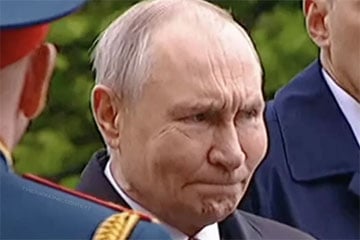
Putin's disgrace has become evident.
Putin has once again become the butt of jokes after the celebrations marking Russian Navy Day were significantly scaled back. According to critics, this pitiful spectacle only confirmed that the Kremlin is no longer capable of defending Russian airspace from Ukrainian drones.
The annual Navy Day celebration has traditionally served as a demonstration of Russia’s naval might. In previous years, the main event was a large-scale naval parade in St. Petersburg, when dozens of ships from the Baltic Fleet sailed down the Neva River to the sounds of orchestras and with great pomp.
This year, there was not a trace of that former grandeur. Due to the threat of drone attacks, the celebrations were reduced to a modest ceremony in an unremarkable courtyard, where not a single warship was present. Instead of a display of military might and the fleet, there was a speech by Putin to a small group of officers next to a huge image of a submarine.
For a man who for many years had sought to restore Russia’s status as a global military superpower, this looked quite humiliating.
This episode was just one of many in a series of high-profile humiliations that clearly demonstrated how much the security situation in Russian airspace had deteriorated. In early May, due to the threat of attacks by Ukrainian drones, Putin was forced for the first time in decades to hold the Victory Day parade in Moscow without military equipment.
Fearing possible attacks, the Kremlin leader even appealed to U.S. President Donald Trump to help broker a temporary ceasefire. Volodymyr Zelenskyy took advantage of Putin’s obvious nervousness and, in response, published a satirical “presidential decree” ostensibly authorizing the parade.
A few weeks later, Ukraine “marked” the opening of the St. Petersburg International Economic Forum in its own way, launching long-range drone strikes against the city’s main oil terminal and a naval base. As foreign delegations were heading to the opening ceremony of Russia’s premier economic forum, huge plumes of black smoke were already rising over St. Petersburg.
Putin’s inability to ensure the safety of foreign guests in his own hometown has become a serious personal humiliation for him.
In recent months, Ukraine has significantly intensified its campaign of strategic strikes, and their consequences have long since gone far beyond symbolic blows to Vladimir Putin’s pride. During the first seven months of 2026, long-range attacks by Ukrainian drones on military and industrial targets deep within Russian territory seriously disrupted the operations of the Kremlin’s war machine, inflicted tangible damage on the economy, and triggered Russia’s most severe fuel crisis since the collapse of the Soviet Union.
In addition to military facilities and oil refineries, Ukraine’s air campaign has recently expanded to include logistics facilities through which the Russian army receives everything it needs for the war in Ukraine—from body armor to drone components.
The main target has been Russia’s largest online retailer, Wildberries: in July, several of its major distribution centers were damaged or destroyed. Combined with fuel shortages, the strikes against the country’s largest retail and logistics network are increasingly forcing millions of ordinary Russians to feel the consequences of the war unleashed by Putin.
Meanwhile, the Kremlin is finding it increasingly difficult to cope with the growing frequency of Ukrainian medium-range drone strikes on logistics facilities located dozens of kilometers from the front lines. Occupied Crimea has become the main target of these attacks. Ukrainian drone units are seeking to establish fire control over all transportation routes to the peninsula, creating what some Ukrainian officials are already calling a “logistical blockade”.
Ukraine’s large-scale aerial campaign has been made possible by the rapid development of the domestic drone industry during the war. When the full-scale invasion began in February 2022, only a few companies were manufacturing drones in the country.
However, it very soon became clear that relatively inexpensive drone technology was precisely what could help Ukraine offset Russia’s overwhelming superiority in manpower and conventional weapons. Four years later, Ukraine is now producing millions of unmanned systems annually and is rightly considered one of the world leaders in unmanned warfare.
This unprecedented expansion of its domestic drone production has allowed Kyiv to exploit vulnerabilities in Russia’s air defense system. For centuries, Russia’s vast size was considered its main military advantage. However, in the era of long-range drones, distance no longer guarantees safety.
When the Kremlin was directly confronted with the growing threat of Ukrainian strikes, it became clear that it did not have enough air defense assets to simultaneously cover its troops in Ukraine, defend major Russian cities, and protect critical infrastructure.
As a result, Putin has had to set priorities, concentrating defenses around the most critical targets—first and foremost Moscow—while many other regions remain virtually unprotected.
Ukrainian drones alone are not capable of defeating Russia, but Kyiv’s campaign of long-range strikes has already changed the rules of this war. The conflict, which for a long time was confined exclusively to Ukrainian territory, has now returned to Russia itself and is having an increasingly tangible impact on the lives of millions of Russians. Combined with the inability of Putin’s army to achieve significant success on the front lines, this undermines the Kremlin’s main narrative about Russia’s supposedly inevitable victory.
Putin has so far shown no signs of being willing to abandon his maximalist goals and continues to seek the destruction of Ukrainian statehood. However, his bellicose rhetoric rings less and less convincing against the backdrop of canceled military parades and burning oil refineries.
If Ukraine manages to maintain its current momentum into the second half of 2026, the pressure on Putin to begin genuine peace talks will only intensify.
Peter Dickenson, New Voice

Bank's name: Bank Millennium S.A.
Address: ul. Stanislawa Zaryna, 2A, 02-593, Warszawa
IBAN: PL97116022020000000216711123
SWIFT: BIGBPLPW
Name of the account holder: Fundacja “KARTA ‘97”
Purpose/title of payment: Donation for statuary aims
You can contact us by the e-mail charter97@gmail.com