

Work Has Begun On Establishing The World Belarusian Congress
1- 10.09.2026, 17:13
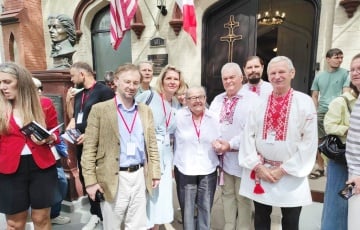
Photo: racyja.com
Belarusians need a permanent mechanism for communication and coordination.
From September 5 to 7, 2026, New York City hosted the 36th Gathering of Belarusians in North America—the oldest regular forum of the Belarusian diaspora in the U.S. and Canada. One of the key outcomes of the event was an appeal to Belarusian organizations and communities in various countries to join forces to establish a World Belarusian Congress, reports “Radyo Racyja”.
“The meeting took place in the parish hall of the Cathedral of St. Cyril of Turov of the Belarusian Autocephalous Orthodox Church in Brooklyn,” the forum’s organizers said. “About a hundred people took part in it.
In addition to Belarusians from the U.S. and Canada, representatives of the Belarusian diaspora from the United Kingdom and Poland were present at the meeting. The United States was represented by participants from New York, Washington, D.C., Minnesota, Florida, Pennsylvania, and other regions, while Canada was represented by delegates from Toronto, Ottawa, and other cities. Leaders of the Association of Belarusians in the United Kingdom also took part in the gathering. Such a wide geographic range of participants made it possible to hear diverse views on the state of the Belarusian diaspora and possible avenues for its further cooperation.
The tradition of holding gatherings of Belarusians in North America was established in 1952 by representatives of the postwar wave of emigration to the United States and Canada. For more than seven decades, this forum has remained one of the oldest forms of organized cooperation among Belarusians living abroad.
This year’s forum had a distinctly socio-political and national focus. Events in Belarus and around the world, threats to Belarusian statehood, a new wave of emigration, and a significant expansion of the Belarusian presence in various countries raised questions for participants not only about preserving traditional communities but also about new forms of joint action and shared responsibility for the future of Belarus.
The event’s program centered on two main themes: the current state and prospects of the organized Belarusian diaspora in North America, as well as its cooperation with Belarusians in other parts of the world. During the discussions, topics covered included inter-organizational cooperation, funding for joint projects, promoting Belarus’s interests on the international stage, the information environment, independent Belarusian media, culture, book publishing, academic activities, and the preservation of national identity. Participants warmly welcomed Ivona Survilla, Chair of the Rada of the Belarusian People’s Republic, who had traveled specifically to attend this gathering. A greeting from Zenon Poznyak, leader of the “Free Belarus” national liberation movement, was read by Yuri Belenkyi — a deputy of the 12th Supreme Council of Belarus and a participant in the historic events of 1991. Those present also watched a video message from Pavel Severinets and listened to a speech by Pavel Shurmey, former commander of the Kastus Kalinovsky Regiment.
The video message from Archbishop Sviatoslav, Primate of the Belarusian Autocephalous Orthodox Church, recorded in Ukraine, made a particularly strong impression. At that time, he was in Chernihiv, having recently been wounded in an attack by a Russian drone. His message from war-torn Ukraine resonated deeply with those gathered.
On Sunday, a divine service and prayers for Belarus were held in the cathedral. On either side of the white-red-white flag were the flags of the United States and Canada—countries where generations of Belarusians have successfully formed and preserved their national communities.
The central theme was the consolidation of the Belarusian diaspora and the creation of a permanent mechanism for cooperation among Belarusian organizations in different countries. A roundtable discussion titled “Consolidation and Coordination of the Belarusian Diaspora’s Activities to Ensure Belarus’s Effective Presence in the World and Support the Country’s Independence and Democratic Development” was dedicated to this topic.
Participants noted that the global Belarusian community possesses significant human, professional, and organizational potential; however, regular communication and the exchange of information between its various centers remain insufficient.
The roundtable’s concluding remarks stated: “Occasional cooperation no longer meets contemporary needs. A permanent mechanism for communication and coordination is needed.”
In this context, a key principle was formulated: coordination does not mean subordination. Existing Belarusian organizations must retain full autonomy, while a joint structure is intended to facilitate collective action toward achieving goals that are difficult to realize individually.
The proposal to establish a World Belarusian Congress sparked a discussion. During the discussion, various opinions were expressed: some questioned the need for a unified structure at this stage, while others argued that the priority should be the development of horizontal ties between existing organizations. Supporters of a more systematic approach noted that horizontal cooperation is necessary but, on its own, does not solve problems that require unified representation, coordination, and the pooling of resources.
The issue of international representation was also discussed. An appeal to the state or an international organization by a single entity representing hundreds or thousands of people carries a certain weight; however, the voice of a representative body drawing on a broad global Belarusian community can carry significantly more weight.
That said, there is no intention to create some sort of “leadership over the diaspora.” The proposed mechanism should be international, inclusive, and pluralistic, bringing together authoritative representatives from various circles while preserving the autonomy of individual organizations.
Modern technology makes it possible to create such a permanent platform without the need for frequent and costly in-person meetings.
In this regard, the roundtable participants deemed it appropriate to put the idea of establishing a World Belarusian Congress up for broad discussion among Belarusians around the world.
The issue of the need for broader global coordination was raised two years ago during the 35th Meeting of Belarusians in North America, held in Canada. However, at that time, it remained largely just an idea. Over the next two years, both previous experience and models of global self-organization among other nations—Ukrainians, Poles, Estonians, and Czechs—were studied. Consultations and meetings were held with Belarusian public and political figures.
The 36th gathering marked the next stage: the transition from discussing the very necessity of such a structure to proposing the launch of an open process for its joint formation.
“This does not mean that the model of the Congress has already been determined. On the contrary, the principles of representation, structure, mandate, and forms of activity must be the subject of broad discussion among Belarusian organizations and communities in various countries,” stated the meeting’s organizers.
The document notes that in a situation where millions of Belarusians are deprived of the opportunity to freely participate in the socio-political life of their country, the Belarusian diaspora takes on special significance as an integral part of the Belarusian nation. The participants proceed from the premise that democratic change in Belarus is inevitable and consider it important to preserve and develop the human, intellectual, professional, and organizational potential of Belarusians abroad, viewing it as a national resource for the future democratic Belarusian state.
The knowledge, professional experience, and international connections acquired by Belarusians in democratic countries should serve to restore the rule of law and foster the development of civil society, science, education, culture, the national economy, and local self-government.
The discussion resulted in a concrete appeal adopted on behalf of the participants of the 36th Meeting of Belarusians in North America.
It is grounded in historical reality: wars, imperial occupations, political repression, and new waves of forced emigration have scattered millions of Belarusians across different countries and continents. However, one’s place of residence does not negate belonging to a single nation:
“No matter where we live, we remain a single Belarusian nation. No Belarusian community abroad can replace Belarus.”
It is proposed that the World Belarusian Congress serve as one of the instruments for such unity — a representative and coordinating body capable of uniting Belarusian organizations and Belarusians from different countries, ensuring the international representation of the Belarusian nation, and coordinating joint actions in its interests.
The concept of the World Belarusian Congress is based on the continuity of the Belarusian tradition of statehood—from the Principality of Polotsk and the Grand Duchy of Lithuania, through the national liberation uprisings of the 18th and 19th centuries, the national revival and the Belarusian People’s Republic—all the way to the restoration of Belarus’s state independence on August 25, 1991.
“The Belarusian diaspora has been and remains an integral part of this history,” said the organizers of the meeting. “For decades, it has preserved the Belarusian idea of statehood, language, and culture; established social, religious, scientific, and cultural institutions; and maintained Belarus’s international presence.”
A new wave of forced emigration in the 21st century has significantly expanded the presence of Belarusians abroad, while simultaneously increasing the responsibility of those living outside the country to preserve the nation’s potential.”

Bank's name: Bank Millennium S.A.
Address: ul. Stanislawa Zaryna, 2A, 02-593, Warszawa
IBAN: PL97116022020000000216711123
SWIFT: BIGBPLPW
Name of the account holder: Fundacja “KARTA ‘97”
Purpose/title of payment: Donation for statuary aims
You can contact us by the e-mail charter97@gmail.com