
Baltic–Black Sea Axe: brake to become a locomotive engine?
14- 21.01.2009, 9:54
Life has made execute an idea of the Black Sea–The Baltic Sea corridor for those who was braking.
On the day of Obama’s inauguration and resuming Russian gas supplies to Europe, heads of Belarus and Ukraine Alyaksandr Lukashenka and Viktar Yushchenko met in Chernigov. It was a clear signal to the West and the East. This signal is double –both of them didn’t accepted Medvedev’s invitation and didn’t visited gas summit held in Moscow last Saturday.
The Belarusian-Ukrainian meeting at highest level has been postponed for a long time to take place amid the aggravation of Russian-Ukrainian relations and melting of Belarusian-European relations.
In the presence of journalists, Lukashenka reminded about a proposal of the Ukrainian president on creating the Black Sea–Baltic Sea corridor. “We are ready to cooperate with your country and with Baltic countries in this direction,” he said.
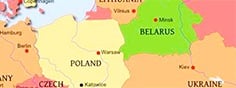
The ideas, expressed by Belarusian politician Anton Lutsevich in the beginning of the XX century and renewed in 1990ies, are based on understanding of mutual interests of the states between the Black and the Baltic Seas. Over the time, structure of economy has changed unlike geopolitical reality. On the East lies Russia with its interests, and energy security can be achieved only by adding new South-North streams to old East-West ones.
Belarus is a link in the Eastern European chain, Baltic–Black Sea Axe won’t be full without Belarus.
What concrete forms may cooperation between Ukraine and Belarus take today?
According to Yushchenko, an agreement was reached in Chernigov on resuming electric energy supplies to Belarus and via Belarus to the Baltic countries, which will lack electric energy after Ignalina nuclear plant is closed. This project was discussed in Homel by vice premiers of Belarusian and Ukrainian governments Uladzimir Syamashka and Alexander Turchinov on January 15. They accompanied their presidents in Chernigov as heads of the joint international commission on trade and economic cooperation.
Yushchenko and Lukashenka agreed on a trilateral meeting of foreign ministers of Lithuania, Belarus, and Ukrainian in Lithuania to prepare necessary draft decision.
The parties also discussed other initiatives, interesting for the both countries as well as for Poland and the Baltic countries, including new Viking corridor which is to link Scandinavia and Turkey.
Another point of mutual interests is gas sector. For the last years, Gazprom was successfully blocking coordination of actions of Ukraine and Belarus by discounts. Speaking about the conflict this year, Yushchenko underlined “we will never have the gas policy in the form we had it before January 1, 2009. Ukraine, Belarus, Russia, and the European Union will get the experience. We won’t be careless and credulous any more.”
In the course of time, Ukraine and Belarus would create a joint route to transit oil and gas from the Caspian region.
Lukashenka emphasised that project of Odessa–Brody oil pipeline didn’t lose its topicality for Belarus. “We can secure the Baltic countries and Poland with oil via our transporting system,” A. Lukashenka said. He thinks if this project works, it will be profitable to process Caspian oil on Belarusian oil refineries.
The two countries have mutual interests in other sectors, too.
Leaders of Belarus and Ukraine have different political genealogy. One created autocracy and intended to rule it for an indefinite time, the other came to power as result of a peaceful revolution and is going to leave his post next winter, after his term expires.
One has scars on his face after dioxin poisoning, produced in Russian laboratories. The other has ruled for 15 years, jollying people with Russian gifts. However, current economic situation makes them talk.
“We are expecting you to pay a working or official visit to Minsk at any time. Our people also waiting for your visit with great interest,” journalists quote Lukashenka.
But cooperation between the two countries has another significant obstacle – difference in political systems.
All countries of the Baltic and Black Sea region, except for Belarus, are democratic. Lukashenka hasn’t been invited to international meetings of head of states of Central and Eastern Europe for 10 years.
An example of the European Union shows that effective cooperation is possible only among the countries of the same political system and political culture. That’s why nearly four-hour talks in Chernigov couldn’t but went beyond the economy. Though it was a face-to-face meeting and details are unknown, Lukashenka thanked Yushchenko for “huge permanent support” at all levels of communication with European and American partners that helped to “establish a dialog between Belarus and the West”.