
David Kramer: Lukashenko brought Belarus to the brink of economic ruin
53- 13.03.2012, 11:52
Belarusians last year beginning to blame the government and Lukashenko personally.
Susan Corke and David J. Kramer discuss Russia’s relationship with Belarus in the upcoming edition of New Eastern Europe. Here we offer an abbreviated version of the article.
Russia calculated that Belarus’s desperation presented a Faustian opportunity for it to regain influence over the country. With the recent added tensions, this deal may bedevil the West’s hopes for democratic reform in Belarus.
After nearly two decades in power, authoritarian leader Alexander Lukashenko brought Belarus to the brink of economic ruin in 2011 with a collapsing currency, severe shortages, soaring infl ation, and dwindling hard currency reserves. Lukashenko’s gross economic mismanagement, combined with his ongoing political crackdown, caused his support among Belarusians to drop to an all-time low last September, down to nearly 20 per cent according to a poll conducted by Oleg Manaev from the Minsk-based Independent Institute of Socio-Economic and Political Studies.
It all started going badly wrong for Lukashenko with the December 2010 presidential election, which was widely condemned for fraud and vote-rigging, and then the brutal assault on protesters. Up to that point, Lukashenko had been able to get away with limiting political freedoms in exchange for providing economic stability in the country. But as the value of the Belarusian rouble plummeted, store shelves became empty and real wages declined against the rising prices of consumerstaples, with the population last year beginning to blame the government and Lukashenko personally. As 2011 drew to a close, many observers, including these two authors, began to think that Lukashenko faced his gravest crisis to date and that his days as “the last dictator in Europe” might be numbered. As history has shown us in other places, however, it may take longer than expected to unseat a determined dictator. Russia offered a devil’s bargain to Lukashenko that he could not refuse if he wanted to remain in power.
Last November, Russia stepped in with the offer that Lukashenko had long resisted: cash for control of Belarus state-owned assets, such as the sale of Beltransgaz to Russian Gazprom for $2.5 billion. In addition, Russian leaders are offering Minsk $10 billion to build a nuclear plant and are giving Belarus special gas discounts (this is after Russia had reduced energy subsidies to Belarus which exacerbated the fi nancial crisis). For then-Russian Prime Minister Vladimir Putin, this was another step in advancing his idea of creating a Eurasian Union. It also constituted a defence against having the West’s frontier move closer to Russia’s border. Moreover, Russians are beginning to gain control of Belarusian banks and media outlets. In the short term, these Russian investments and loans have helped Belarus avoid a total economic collapse and provided a lifeline to prop up Lukashenko, at least temporarily. Nonetheless, the price being paid to preserve Lukashenko’s grip on power in terms of Belarus’s independence and assets may engender signifi cant blowback among the elite and population.
Belarus’s financial crisis was a long time in the making, dating back to Lukashenko’s rise to power in 1994 (ironically, through a relatively free and fair election). Instead of adopting the path of political liberalisation, economic reform, and privatisation with the other countries of Central and Eastern Europe after the fall of the Soviet Union, Lukashenko retained a communist-like system including a mismanaged, state-controlled economy that was unsustainable in the long term. Lukashenko has been and continues to be determined to preserve his own power by any means, and has thus avoided changing course from authoritarian rule and corruption. He has acquiesced to Putin’s asking price for helping him stay in offi ce and stave off protests – but a steep asking price it is. Despite Belarus’s relative isolation, the global economic crisis added further pressure in 2007 and 2008 to Belarus’s financial position. Initially, Lukashenko tried his hand with the West, though only after he caved in to economic sanctions imposed to win the release of political prisoners in 2008. He signalled that with the right fi nancial inducements, he would be open to reforms, and the West, especially the European Union, fell for his tricks and sought to encourage progress to bring this pariah state into the European fold. Th e International Monetary Fund (IMF) also provided a 2.5 billion dollar emergency loan package at the beginning of 2009. Instead of using the funds as the IMF intended, namely to restructure and liberalise the domestic economy, Lukashenko used the funds to artifi cially prop up his system through stimulated GDP growth and pre-election boosts in pensions and wages.
The EU jumped in as well, eager to try to use this perceived opening to encourage reforms by inviting Lukashenko to the inaugural Summit of the Eastern Partnership More talk about sanctions is not enough: the time to act was yesterday.
Initiative in 2009, even though less than a year before he had been the target of sanctions by the West. Playing to the West’s desire to advance human rights in Belarus, Lukashenko turned political prisoners into a business by putting them in jail and then releasing them as a gesture of good faith and progress – and in turn, was rewarded for doing so. There was the promise of additional EU fi nancial assistance conditioned on demonstrable signs of progress in Belarus. Holding the December 2010 presidential election in compliance with international democratic standards was considered to be a key test, and billions in EU assistance were dangled before him if he allowed a decent election. Alas, as we all know, Lukashenko failed spectacularly.
Susan Corke is Director for Eurasia Programs at Freedom House based in Washington DC.
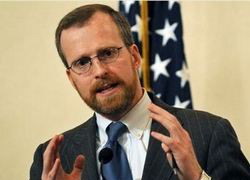
David J. Kramer is the President of Freedom House.
New Eastern Europe’s April-June edition