Lukashenko Is Burying Vitebsk Region Once Again
2- 15.10.2026, 15:56
- 1,600
Three key takeaways from the dictator's trip.
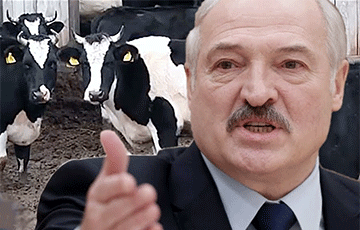
On October 15, the governor traveled to the Verkhnedvinsky District to assess the situation in the agricultural sector of northern Vitebsk Region.
Let’s highlight three notable aspects of this seemingly routine trip, the likes of which have become increasingly common in recent months.
First, Lukashenko continues to mentally write off the Vitebsk Region: “There can be no discussion. There must be the strictest military discipline here. But people must also be paid if they work. That’s the only strategy. I see no other strategy. This region will perish if we don’t do this.”
At the same time, he has questions for his own appointees—from the Minister of Agriculture to the heads of districts and the region: “What are we going to do here? Braslav, Miory, Verkhnedvinsk, Rossony. Northern Belarus. What’s the strategy?”
“I need to save these districts. There are 4–5 of them here. For me, the main thing is to keep the people here. To preserve this territory,” says Lukashenko.
Second, the leader is no longer interested in impressive statistics. When he asked Agriculture Minister Yuri Gorlov about the expected total grain harvest, Lukashenko was not only unimpressed by the record-breaking forecast but also clearly stunned those present: “Your figures are important to me, but not that much. What matters is money.”
That’s understandable. He knows better than anyone how, over the decades of his rule, officials have learned to cook the books. The State Control Committee won’t let them lie. But inflated figures don’t bring in more money.
It’s telling that Lukashenko himself acknowledges the flaws in his own system of governance, where without his valuable instructions (most recently: “Cabbage is fine, but we need to get the carrots out as quickly as possible. What if there’s a frost?”) no one will lift a finger.
“That’s why I’m pushing you, pushing you… To get things moving. So that you can work without me later on. That’s why I’m paying attention,” the leader said.
And the third point—the continued shift toward private enterprise. During the trip, Lukashenko insistently offered Nikolai Vorobey, a businessman close to him, a portion of the land in the Verkhnedvinsky District, promising support: “There’s no big money. We’ll subsidize you, just like everyone else.”
In addition, the Minister of Agriculture—whom he himself appointed, the fifth since 2020, was repeatedly urged to draw on the management experience of the “Krasny Bor Agro” enterprise, owned by Vorobey—from planting corn for feed to using triticale in compound feed.
This seemed humiliating, given that Gorlov has an entire ministry and an army of specialists behind him, represented by a number of research and practical centers across the country. But it seems that fear for the future of the Vitebsk region (and beyond) is pushing the governor to take steps that even he himself is not enthusiastic about.
Artem Sinitsyn, “Solidarnast”

Bank's name: Bank Millennium S.A.
Address: ul. Stanislawa Zaryna, 2A, 02-593, Warszawa
IBAN: PL97116022020000000216711123
SWIFT: BIGBPLPW
Name of the account holder: Fundacja “KARTA ‘97”
Purpose/title of payment: Donation for statuary aims
You can contact us by the e-mail charter97@gmail.com