The Generation Z Uprising
1- 16.10.2026, 13:02
- 1,858
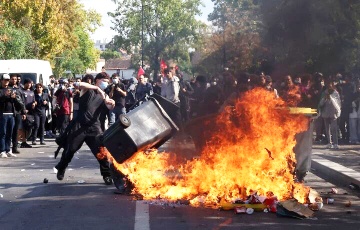
There are three interesting aspects to the student protests in France.
School protests have been ongoing in France for nearly a month now, and they have spread to French-speaking Belgium as well. Teachers and school staff stand alongside high school students on the barricades, shielding the students from police batons and tear gas. And in between protests, students are catching up on what they’ve missed: some teachers and tutors are posting educational materials on social media and online platforms. Student volunteers are organizing online tutoring sessions on Discord and TikTok.
This differs somewhat from the image portrayed in the news—teenagers on barricades, clashes with the police, closed schools, and the injured. It suggests a simple explanation: we are witnessing yet another riot fueled by youthful radicalism. But this overlooks the main point—the meaning of the protest itself.
Three reasons for the unrest are usually discussed, and these are the ones student union leaders cite first and foremost: a shortage of teachers, overcrowded classrooms, and inadequate school funding. In reality, however, the protesters are making more demands—there are ten listed on the student unions’ website, ranging from school-related issues to a fair university admissions system.
The students’ protests did not arise out of nowhere—at the same time, teachers, along with other public-sector employees, are protesting against the government’s plans to cut budget spending and freeze salaries.
On the eve of the presidential election, society is becoming polarized, with the government accusing the opposition of inciting the student protests, and the opposition accusing the government of police brutality.
But if we set aside the political noise and the romanticization of barricades, we can see that some of the educational issues that drove French students into the streets are familiar to our society as well. That is why this experience is of interest to us. This isn’t about calls to take to the barricades—in a country currently fighting for its very right to exist, internal barricades are unacceptable. But we can compare how society reacts to educational problems and how the pressure builds up.
There are three interesting aspects to the French experience.
1. Solidarity between teachers and students
In fact, the protest movement was not started by students, but by teachers at a single school in Créteil, a poor suburb of Paris. They took to the streets to protest because their school lacked teachers and funding.
And then the students joined them. ““We said to ourselves: let’s try it the next day too—we’ll make our voices heard and try to change something,” the high school students told Radio France… “We’re not asking for luxury; we’re just asking for the bare necessities, really.”.
The students blocked the school entrance with trash cans and began sharing videos about their school and the protest on social media. In response, high school students from other schools and cities across France began doing the same.
“They (the students) see the same reality as we do, and they’re angry,” explained Caroline Cheve, a teachers’ union leader, to The Guardian.
Can you imagine a situation in Ukraine where students would stand alongside teachers at a protest? It sounds fantastical, but it’s possible—provided that the teachers themselves resolutely defend their rights. So far, this has been a problem: there are a few brave souls, but most have grown accustomed to enduring and remaining silent.
A recent example: Today I read a discussion among teachers on social media about how, in some communities, they’re being forced to write letters of resignation at their own expense during the fall break. “I wrote mine—has anyone else faced this?” — I read in the post. The responses from those who’d faced this were along the lines of “Well, what can you do? I have to” and “One person can’t make a difference.” And there was only one comment asking, “What if we just refuse?”
A year ago, on the eve of the state budget’s adoption, education workers’ unions organized a social media flash mob against the curtailment of teachers’ rights and in support of higher salaries for them. Teachers were asked to take photos at their workplaces, and students, parents, and “anyone who cares” were asked to show their support. But the flash mob didn’t catch on among students: teenagers can’t be persuaded to show support just because they’re told to from above—only topics that have energy and a shared vision really resonate.
There is also a second reason for the isolation of teachers’ protests: we’ve grown accustomed to viewing problems with schools and teachers’ salaries as the teachers’ own responsibility. Parents don’t see a direct link between their child’s future and their teacher’s situation. And if they disagree with something or are dissatisfied, they hire a tutor or chip in money for the school’s needs.
Meanwhile, in the current student protests in Belgium, one of the key demands is the revision or repeal of an educational reform that increases teachers’ workload without raising their salaries.
2. Education for all, not just the select few
The protest by French students, which began as a desire to improve learning conditions, quickly took on a social dimension. Underfunding affects all schools, but it hits hardest in poor neighborhoods with diverse ethnic and immigrant populations.
“Everyone told us that school levels the playing field. But today that’s simply not the case,” says 16-year-old Isabella in a comment to The Guardian. “A teenager from the suburbs of Paris will never have the same opportunities as a student from the city center. That’s exactly why we’re here today.”
Equal access to education for everyone, regardless of where they live or their family’s income, is one of the students’ key demands. They view education as a common good and a starting line: it determines what kind of foundation a person will have as they embark on life. That is why students from wealthy Parisian high schools stand side by side with teenagers from disadvantaged suburbs on the barricades. A teacher at the prestigious Lycée Sophie-Germain, who supports the protesters, told The Guardian that students from central Paris have shown great solidarity with their peers from the suburbs, which contradicts the notion that we live in an age of selfishness.
The phrase “era of selfishness” is often heard in France these days—there is active discussion here of sociologist Camille Penya’s new book, *The Triumph of Selfishness: A New Form of Social Coercion.” The author pays particular attention to education—he argues that when, despite the rhetoric of “equal access to education,” the state withdraws from leveling the playing field, fierce competition for future social status shifts into the classroom. In this struggle, the wealthy and the middle class convert their wealth and connections into educational advantages for their children, and “self-interest” itself ceases to be a personal choice—it becomes a compulsory strategy for survival in a society without guarantees. It’s every man for himself.
Peñi sees the “ethics of dignity” as a way out of this situation: the recognition that every person has the right to a dignified life, and that ensuring this dignity is a shared responsibility of society, not a private matter for individual families. And it is precisely in this sense that the solidarity protests by teachers, students, and parents in France can be seen as a sign of hope that this is possible.
In this context, it becomes clear why the students’ demands include not only financial support for schools but also a fair university admissions system. The protesters consider it opaque and unfair, as it gives preference to students from prestigious schools.
Ukraine is also familiar with inequality in education. The gap in test scores between urban and rural students is documented by the EIT-NMT, national monitoring studies, and PISA. We are constantly discussing what a fair admissions process should look like and whether we should give admission preferences to certain groups of applicants.
Given that people and talent are the main assets of a country fighting for its very existence—and that young people leaving the country are predominantly from cities—students from small towns and villages will soon become the country’s main resource. The task of improving education in these areas must become a national priority. This was important before, but now it has become critical.
3. The Generation Z Uprising
The teenagers who took to the streets today in France and Belgium were born between 2008 and 2010. These are children who entered the most formative years of adolescence during the COVID-19 lockdowns. They are growing up under the pressure of alarming news about military conflicts—and some know this from their own experience or that of loved ones (the protests, I should remind you, began in poor, multicultural neighborhoods with a high proportion of migrants). Add to this news about climate threats, the economic crisis, and protests in their home country. Students fear that their future will be worse than their parents’ lives.
In comments to the media, protesters describe how stressed they are about grades, exam results, and the inability to prepare for college admissions due to a lack of teachers. They refuse to accept the notion that they must “put up with it because that’s the way things are in the country where you live,” and the police’s harsh response only deepens their distrust of a government that fails to uphold the social contract. The signs held by the students read: “A state that uses tear gas against high school students is a weak state,” “We’re not here to cause trouble.”
Another defining feature of this generation is its familiarity with technology. It doesn’t need top-down coordination to organize—it organizes itself horizontally through social media.
Adults recognize many of the students’ demands as fair. But before the student protests began, those demands were not being met. For example, a bill to reform the admissions system has been pending in parliament since February, but only now has Prime Minister Sébastien Lecornu promised to make the process more transparent. The government now acknowledges that some of the students’ demands are “entirely justified” and has announced plans to address the issues of teacher shortages and school funding. Previously, Education Minister Édouard Géfrey had publicly stated that the shortage of teachers in schools would not be too severe.
And this is a good lesson, including for the Ukrainian government, which has traditionally presented the public with a glossy picture of education reforms without openly addressing the real problems.
There is also a broader context: we are witnessing a crisis in the old education system, which is still trying to function as an industrial assembly line for “churning out” workers for the labor market. Meanwhile, a generation that lives in a high-tech and dynamic world has entered this system. Education must transform, and this is a challenge for all countries.
Oksana Onishchenko, ZN.UA

Bank's name: Bank Millennium S.A.
Address: ul. Stanislawa Zaryna, 2A, 02-593, Warszawa
IBAN: PL97116022020000000216711123
SWIFT: BIGBPLPW
Name of the account holder: Fundacja “KARTA ‘97”
Purpose/title of payment: Donation for statuary aims
You can contact us by the e-mail charter97@gmail.com