Oil, Iran, And Russia
1- 16.10.2026, 13:37
- 1,688
Nothing is out of the question.
The war in the Strait of Hormuz threatens to become a permanent state of affairs. This is giving rise to catastrophic predictions of a collapse in the oil market and the resulting downfall of the global economy. Nothing can be ruled out, but the experience of 21st-century crises does not support these expectations.
Let’s start with the bad news. Let’s look at the global oil and gas landscape, beginning in 2013. That year serves as a suitable starting point. It was the last peaceful year before Russia’s first invasion of Ukraine and the last year of high oil prices ($109 per barrel of Brent) before a prolonged decline.
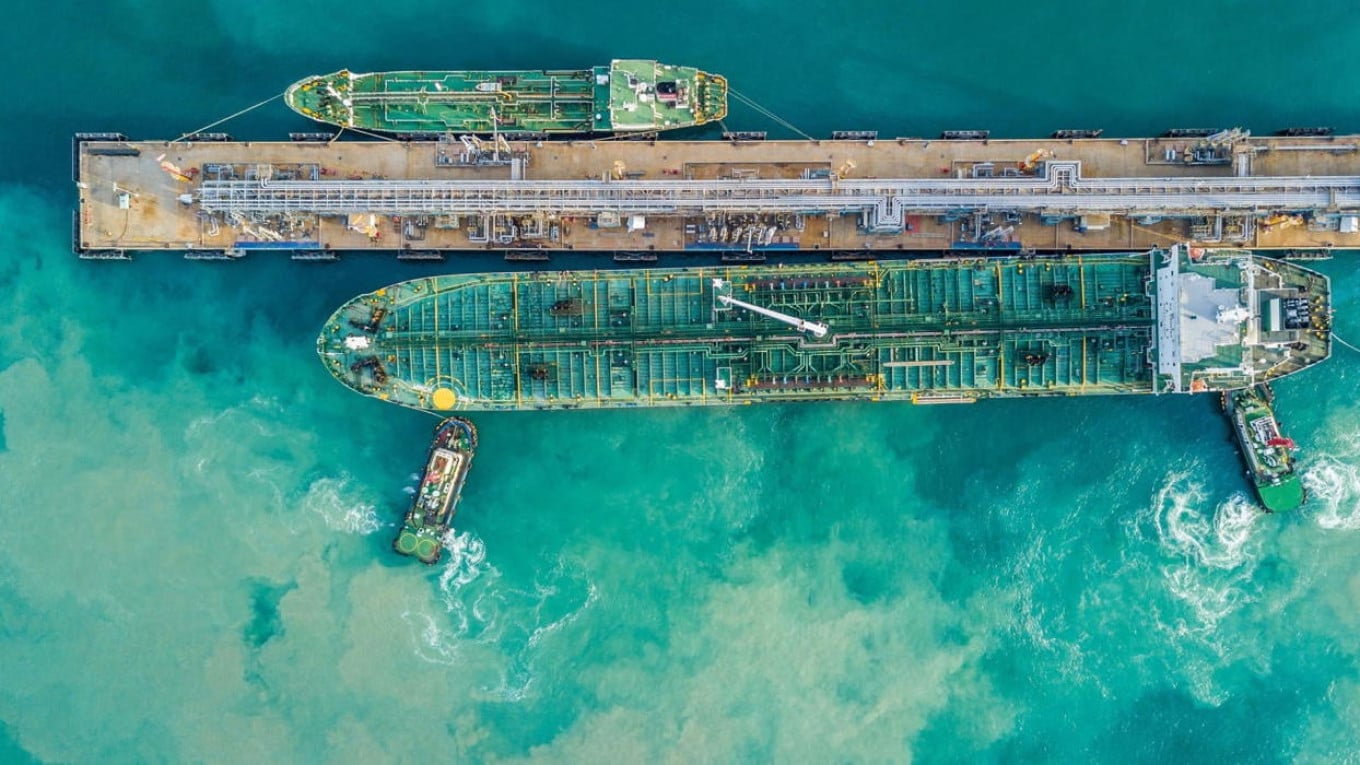
The table below shows what has become of global energy trade over these years of wars, crises, and sanctions, and in what state it found itself at the start of the current campaign in the Strait of Hormuz.
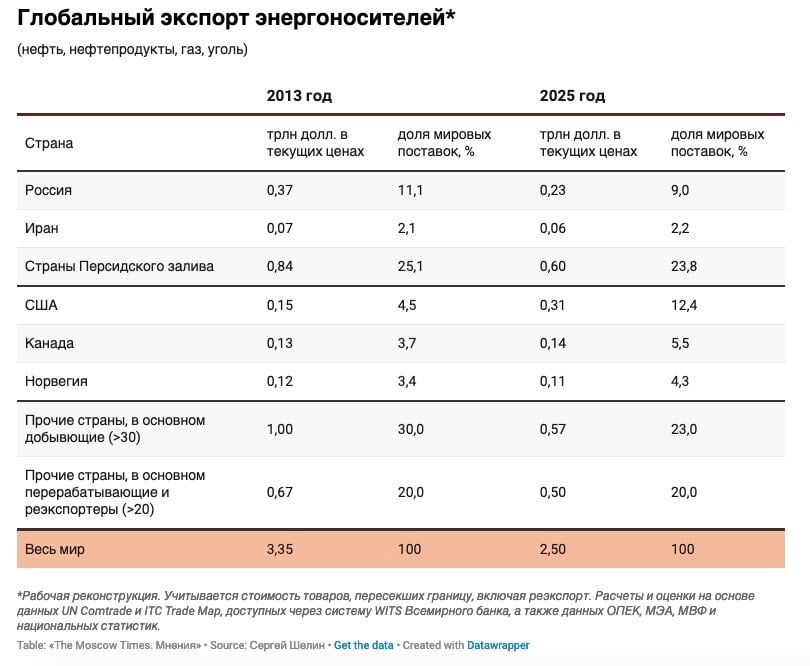
Surprising or not, there haven’t been that many changes. Russia’s share has decreased, but not drastically—at least not until Ukraine began systematically striking oil refining facilities.
And the U.S.’s share has nearly tripled. That is the main change. And there are almost no others to speak of. The contribution of the seven Arab Gulf states to the energy trade has remained just as large as it was. Iran’s contribution, despite all its ups and downs, has as well. At least, that’s what OPEC claims.
Thirteen Turbulent Years
If we add up the shares of countries that have been subjected to military strikes and sanctions (Russia, Iran) or to a blockade and the accompanying destruction (the Gulf states), their combined share of the energy trade declined from 2013 to 2025 only symbolically—from 38% to 35%.
And it is only slightly less than the combined contribution of all other actual energy suppliers on the planet. After all, among the countries listed in the table, the last group (accounting for 20% of energy trade) does not produce energy itself, but only processes or simply re-exports it.
If we assume that energy production in the crisis-stricken part of the world will cease or truly plummet, then indeed: humanity will be in for a rough time. But how likely is that? I think it can be assessed based on the experience of the past thirteen turbulent years.
By 2016, three years after the boom year of 2013, the average annual price per barrel of Brent had fallen by two and a half times (to $44). Understandably, oil buyers were very pleased with this, and that year they purchased 12.2% more energy resources in physical volume, paying significantly less for them than in 2013. However, global GDP growth in 2016 (3.4%) turned out to be even slightly lower than in the “unprofitable” year of 2013 (3.5%).
And in the COVID-19-stricken year of 2020, when the price of Brent crude fell to $42 per barrel, global production actually declined by 2.7%—with global oil supplies falling by 7%. The crisis at that time dealt a severe blow to oil demand, and oil traders had to adapt to it, rather than the other way around.
Over the past 13 years, the physical volume of energy trade in current dollar terms has fluctuated between $1.3 trillion and $3 trillion, but the global economy has barely noticed these fluctuations.
Excluding the COVID-induced downturn, it has grown fairly steadily and has more than doubled since then. By 2025, the physical volume of energy trade had also increased (by approximately 20%), even though those years saw sanctions imposed on its major players, Russia and Iran.
Stagnant but Resilient
Iran, as already mentioned, continued to trade in energy resources—and even prospered—right up until the current campaign. Not so now. In October, there were no crude oil exports from Iran. True, gas exports to Turkey and Iraq actually increased. But the volume is small.
Russia isn’t exactly thriving—it’s stagnating—but no one has yet managed to knock “Putinomics” off its feet. In 2013, Russia’s energy revenues (oil, petroleum products, gas) totaled $350 billion, while in 2016 they amounted to just $150 billion. But the Russian public got off with a temporary decline in living standards and a spike in inflation, while the regime didn’t even consider slowing down its preparations for war.
In 2022, the first year of the current invasion, Russia capitalized on the global panic at the time and earned, in nominal terms, even more than in 2013—$371 billion. Then the panic subsided, and in 2025, they collected relatively little—$203 billion. But the shortfall did not affect war financing. It was a record high, and that record will only be broken this year.
Russia’s energy trade has proven to be extremely resilient, even as its quality declines. Initially, the share of gas in exports fell due to sanctions, and now, due to the impact on oil refining, shipments of petroleum products are also declining.
In 2021, before the war, the share of petroleum products in Russian exports was only 1.6 times smaller than that of crude oil. By September 2026, their share had fallen to just one-fourth that of crude oil, and the volume was 40% lower than in September of the previous year. Trump’s efforts to support Russian diesel production are unlikely to reverse this trend.
But Russia’s main energy product hasn’t gone anywhere. Although oil production has fallen by 8–10% over the past year, it is still sufficient to maintain crude oil exports at the same levels as a year ago. And there are plenty of buyers around the world to turn it into gasoline and diesel.
Temporary but Effective Solutions
On the other hand, trade in energy resources from the Gulf Arab states has also proven quite resilient. It continues despite the war and the blockade. In September, crude oil exports from the region stood at 81% of the pre-war September level. The situation is worse for liquefied natural gas. Exports have fallen by a factor of three or four, but they haven’t stopped either.
Trying to predict the twists and turns of several military campaigns unfolding in this region at once is a hopeless endeavor. However, one can assume that with each new twist and turn, new temporary solutions will be found.
At least, that has been the case several times over the past six months. That is why, although the price of Brent has risen high, it has never been astronomical.
Before the campaign began, in January, a barrel cost $67. In April, it soared to $117. In June–July, it fell to $80–85. Now it’s back above $110. Russian oil, thanks to sanctions-driven discounts, is more affordable and sells for just over $90.
The world has grown unaccustomed to such prices for Brent, but in nominal terms, this is the average level for 2011–2013 ($110–115 per barrel). In real terms, however—adjusted for inflation—it is significantly lower: $77–81 per barrel. The many hundreds of dollars predicted by doomsayers and anarchists never materialized.
Let’s not underestimate the resilience of the global energy trade. This global system is more stable than it appears. It withstood the cutoff of gas supplies from Russia to Europe, and it will withstand a military campaign in the Strait of Hormuz, even if it drags on.
This is no excuse for the President of the United States. But his erratic behavior won’t bring the world to its knees.
Not this time, at least.
Sergey Shelin, The Moscow Times

Bank's name: Bank Millennium S.A.
Address: ul. Stanislawa Zaryna, 2A, 02-593, Warszawa
IBAN: PL97116022020000000216711123
SWIFT: BIGBPLPW
Name of the account holder: Fundacja “KARTA ‘97”
Purpose/title of payment: Donation for statuary aims
You can contact us by the e-mail charter97@gmail.com