


U.S. Army Commanders Outline Key Lessons From The War In Ukraine
- 20.10.2026, 18:25
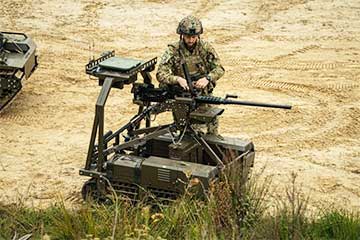
Drones have significantly changed the art of war.
The main lesson for the U.S. Army from the war in Ukraine is that military equipment and troops must constantly change positions, and anything that cannot be moved must be better camouflaged. U.S. commanders are restructuring unit training to account for the fact that drones can detect targets almost continuously, turning stationary positions into easy targets, writes The War Zone.
“If the enemy can see you, he can hit you,” said General Ron Clark, commander of U.S. Army forces in the Pacific region. According to him, mobility and camouflage are becoming critically important skills in an environment of constant aerial surveillance.
The military is also studying ways to deceive the enemy. In Ukraine, smoke screens are used to protect against drones, the color of military vehicles is altered, and other measures are employed to make it harder for automated guidance systems to identify targets. Photos of Russian trucks with unusual camouflage patterns—featuring zigzags and plant motifs—recently appeared on social media.
General Xavier Branson, commander of U.S. forces in South Korea, noted that the military will have to get used to constantly moving between positions.
“You may have to move from point A to A1, then to A2 and A3, before reaching point B,” he explained.
These principles are particularly important for U.S. forces in the Pacific region, where, in a potential conflict with China, troops will have to move between islands, avoid detection, and protect air defense systems and radars from attacks.
The U.S. Army is also studying the use of ground-based and aerial drones to deliver supplies and evacuate the wounded, in order to minimize the risk to service members.

Bank's name: Bank Millennium S.A.
Address: ul. Stanislawa Zaryna, 2A, 02-593, Warszawa
IBAN: PL97116022020000000216711123
SWIFT: BIGBPLPW
Name of the account holder: Fundacja “KARTA ‘97”
Purpose/title of payment: Donation for statuary aims
You can contact us by the e-mail charter97@gmail.com