


A New Challenge For Belarus' Reserves
- 26.10.2026, 9:07
- 1,144
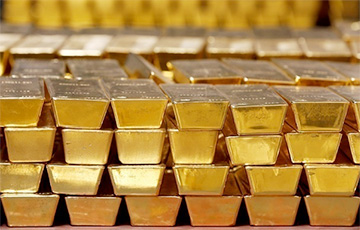
Gold prices are dragging down foreign exchange reserves.
The Belarusian ruble appreciated sharply against the dollar and the euro. The Belarusian ruble’s performance against European and American currencies was influenced by the Russian ruble, which rose steadily amid high oil prices and the central bank’s tight monetary policy. Gold prices fell on foreign markets, which could negatively affect Belarus’s gold and foreign exchange reserves in the coming month.
From October 19 to 26, the following changes occurred in the exchange rates of foreign currencies and the currency basket against the Belarusian ruble:
The value of the currency basket remained virtually unchanged, as in previous weeks, at 0.1751 rubles.
The U.S. dollar fell by 2.12%, trading at 2.9460 rubles.
The euro also weakened (by -2.6%) and stood at 3.2995 rubles.
The Russian ruble appreciated by 1.55% to 3.6597 Belarusian rubles per 100 Russian rubles.
The Chinese yuan fell by 1.94% to 4.4188 rubles per 10 yuan.
The Russian ruble is driving the ruble’s appreciation against the dollar
Over the past week, the foreign exchange market remained influenced by fluctuations in the Russian currency. As a result, the ruble strengthened rapidly against the euro, the Chinese yuan, and the dollar. At the same time, changes against the currency basket were insignificant, amounting to one hundredth of a kopeck. The stability of the currency basket is explained by the parallel weakening of the Belarusian ruble against the Russian ruble.
The Russian ruble continued to strengthen due to prevailing supportive factors. First, this was influenced by the rise in Brent crude oil futures contracts to $114–116 per barrel. The rise in oil prices occurred against the backdrop of escalating tensions in the Middle East. Yemeni Houthis launched military strikes against Saudi Arabia, which is the world’s leading exporter of crude oil. Among other things, energy infrastructure was damaged.
To stabilize the situation in the energy sector, the U.S. Department of Energy announced that it would release 400,000 metric tons of crude oil from its strategic reserves. The level of U.S. strategic oil reserves is at its lowest point since 1982. At the same time, Germany’s State Agency for Oil Stockpiling (EBV) announced a tender for the sale of diesel fuel, fuel oil, and crude oil.
Thus, despite the gradual resumption of shipping through the Strait of Hormuz, the situation in the region remains tense, which is supporting fuel prices and, accordingly, having a positive effect on the Russian ruble’s exchange rate.
Second, the Russian currency was bolstered by expanded opportunities for trade cooperation between Russia and the U.S. Last week, the first tanker carrying Russian diesel fuel was shipped. It is scheduled to arrive in the U.S. in early November.
Third, the Russian currency strengthened following the Russian central bank’s decision to keep the key rate at 14% due to rising inflation. According to the updated forecast, inflation in Russia will reach 7.1%–7.6% by the end of the year. To curb inflation, the regulator is forced to maintain a tight monetary policy. High interest rates are sustaining investor interest in ruble-denominated financial assets.
Finally, the approach of the next tax period also contributed to the strengthening of the Russian ruble and, in turn, the Belarusian ruble.
Gold Prices Fall
In October, the price of gold continued to fall. As of October 14, spot prices for the precious metal had dropped to $4,093 per troy ounce. Since late January, gold has lost 26% of its market value. The price decline occurred against the backdrop of rising yields on U.S. Treasury bonds. Investors preferred to invest in attractive U.S. assets. Such trends are having a negative impact on the dollar-denominated value of Belarus’s gold and foreign exchange reserves, a significant portion of which is denominated in gold.
Future gold price movements will depend on the U.S. Federal Reserve’s decisions regarding interest rate changes.
Additionally, a revaluation of gold in U.S. reserves could influence price movements in the future. The fact is that the price of gold in U.S. reserves has remained unchanged since 1973 and is recorded at $42.22 per troy ounce. A revaluation does not imply additional gold purchases by the U.S., but this move could increase investor interest in the precious metal as a reserve and reliable asset. A revaluation is unlikely to occur in the coming months. However, this issue has been discussed more frequently in public circles.
Short-term forecast: In the short term (from October 26 to November 2), the exchange rate of the Belarusian ruble against the U.S. dollar may fluctuate within the range of 2.91–2.97 rubles per dollar.
Anastasia Luzgina, Senior Research Fellow at the BEROC Center, for “Belsat”

Bank's name: Bank Millennium S.A.
Address: ul. Stanislawa Zaryna, 2A, 02-593, Warszawa
IBAN: PL97116022020000000216711123
SWIFT: BIGBPLPW
Name of the account holder: Fundacja “KARTA ‘97”
Purpose/title of payment: Donation for statuary aims
You can contact us by the e-mail charter97@gmail.com