The Kremlin's Biggest Loss: What The Students' Victory In Serbia Means
- 27.10.2026, 8:42
- 1,868
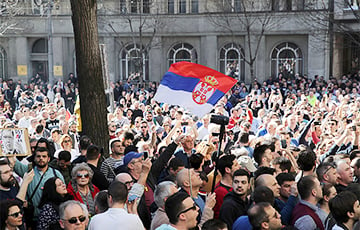
The Russian-style reshuffle failed.
On October 25, Serbia voted against the continued political dominance of Aleksandar Vučić. After nearly two years of protests, his political party lost the parliamentary election to a student movement that emerged from discontent over corruption and the authorities’ actions following the tragedy in Novi Sad. Vučić himself conceded defeat. According to preliminary estimates, the “Student List” could win between 135 and 140 seats in the 250-seat parliament, while Vučić’s political party is projected to win about 105. The final results have yet to be confirmed.
This is a serious blow to Vučić. Not only has he led the country since 2017, but he also effectively set the political agenda long before he became president. His Serbian Progressive Party has been in power since 2012, and Vucic himself served as prime minister from 2014 to 2017. In September, Vučić announced his resignation as president in order to head his party’s electoral list and attempt to return to leading the country as prime minister. It was an attempt to change positions without losing power. The plan did not work out.
This is also bad news for Russia. Vučić was a convenient partner for the Kremlin. He maintained ties with Russia, refused to impose sanctions against it, but at the same time attracted European investment and developed relations with China. Now this arrangement is in question.
The article OBOZ.UA.
The Russian-style power shift has failed
Following the defeat of Viktor Orbán in Hungary, another political system—one that had been built around a single individual for years—has suffered a serious blow. One of Putin’s last remaining supporters in Europe, Serbian politician Aleksandar Vučić, suffered a defeat in the parliamentary elections. Vučić controlled the ruling party, wielded significant influence over state institutions, and relied on a loyal media. It seemed that changing this system through elections would be extremely difficult. However, Serbian voters showed that even a long tenure in power does not guarantee victory.
This turn of events was the culmination of a months-long standoff between the government and the student movement, which had become the focal point of protests against Vučić’s authoritarian system. The opposition’s victory paves the way for the formation of a new government without the need to bring in coalition partners. Other political forces, with the exception of national minority parties that have guaranteed representation, failed to win seats in parliament. The result came as a surprise even to political scientists, who had not predicted such a sweeping defeat for the ruling party.
Events in Serbia do indeed bear many similarities to those in Hungary. In both countries, dissatisfaction with the government gradually turned into support for a political alternative. After the results were announced in Belgrade, people took to the streets to celebrate the opposition’s victory. Péter Magyar, who defeated Orbán, also drew a parallel between the events in Serbia and Hungary.
Vucic tried to retain power by moving from the presidency to the premiership, but the political bloc he led lost to the student-led coalition by nearly 10 percentage points.
He tried to replicate a familiar Russian scenario. In 2008, Vladimir Putin stepped down as president, became prime minister, and Dmitry Medvedev was elected president. The real levers of power remained in Putin’s hands, and he later returned to the presidency. The Serbian scenario had a different legal basis but a similar political logic. Vučić stepped down as president to head the party’s electoral list and run for prime minister. He hoped that this change in status would help him maintain control over the country. Vucic tried to convince voters that he remained essential to Serbia’s stability. However, his resignation did not absolve him of responsibility for the previous years. On the contrary, the election turned into a vote on whether to continue or end his political dominance. The student movement put forward a different demand: to change the rules by which the state operates. This is precisely where the plan failed. Stepping down from office proved insufficient to retain power.
Why Vučić Lost
Immediately after conceding defeat Vucic called the election results confirmation of a “revolution” supported by a number of EU countries. It is difficult to say who, aside from Russia, exerted external influence on these elections, but the main reason for the authorities’ failure lies within the country. The turning point for Serbia was the tragedy in Novi Sad in November 2024. Sixteen people died after a canopy collapsed at the train station. Students demanded that documents regarding the station’s renovation be made public, that possible corruption be investigated, and that those responsible be held accountable. The authorities were unable to stop the protests, which quickly spread across the country. In January 2025, Prime Minister Miloš Vučević resigned. However, this did not satisfy the protesters. Their demands had long since gone beyond the scope of a single disaster.
The students were joined by teachers, farmers, and other citizens. Over time, the demands went far beyond an investigation into the tragedy. People increasingly spoke out about corruption, pressure on opponents, the dependence of state institutions, and the government’s control over the media. The protests turned into a broader movement against Vučić’s political system. The president’s attempt to maintain his influence through parliamentary elections failed.
“The Students” Won, but Can They Change the Country?
A victory over Vučić does not yet mean that his opponents have a ready-made plan for restructuring the state. “The ‘Student List’ has brought together people with diverse views. Among its supporters are pro-European activists, nationalists, teachers, doctors, and representatives of other professions. They were united by the demand to end corruption and restore state institutions to normal functioning.
Unlike the Hungarian opposition led by Péter Magyar, the Serbian movement does not have a single, universally recognized leader. Nor does it offer a political platform clear enough to allow people to understand in advance where it stands on all key issues. During the protests, this feature helped prevent a split over a specific individual. Now it may complicate the formation of a government.
For the Serbian opposition, the hardest part begins after the elections. Forming a government and replacing the country’s leadership is only the first step. It will be much more difficult to dismantle a system in which political power, economic interests, and ties to Moscow have been intertwined for many years. Decisions will have to be made on how to reform the courts and the prosecutor’s office, ensure media independence, investigate corruption cases, and limit the influence of the former ruling team. Controversy may arise in each of these areas. Comprehensive anti-corruption investigations into the activities of Vučić, his inner circle, and business structures linked to the government are necessary—which is, in fact, what voters are demanding.
As for foreign policy, although Vučić’s characteristic geopolitical balancing act may continue, he has already stated that the Student List will impose sanctions against Russia as early as this spring. But there is an important detail: the publicly stated position of the “Student List” itself contradicts this assertion. On September 30, the movement declared that Serbia must maintain a principled stance against imposing restrictive measures on Russia. The students explained this by citing their own historical experience and doubts about the effectiveness of sanctions as a means of resolving political and security issues. Yes, there are supporters of European integration within the movement, but there is no coordinated platform on all key issues. Some of the political forces supporting the student list—in particular, the Movement of Free Citizens—advocate aligning Serbia’s foreign policy with that of the EU and disagree with the rejection of sanctions against Russia. This points to the divisions that the new majority will have to overcome as soon as it begins making concrete decisions.
Russia Risks Losing a Predictable Partner
One way or another, Russia has lost yet another ally in Europe in the form of Serbia. For many years, Serbia remained one of the few European countries that maintained close ties with the Kremlin. Now that arrangement is in question. Of course, the opposition’s victory does not yet mean an automatic break in relations with Russia, but the former predictability in relations between Moscow and Belgrade may no longer exist. Among European leaders who openly maintain close ties with the Kremlin, the main one remaining is Slovak Prime Minister Robert Fico.
Vucic’s defeat deprives the Kremlin of a trusted partner with whom Moscow had maintained personal contacts for years and coordinated on political and energy issues. Vucic knew how to balance between Russia and the West, maintaining ties with both sides. For the Kremlin, this policy was convenient: Belgrade remained open to cooperation with Moscow, even when most European countries were imposing sanctions against Russia.
Serbia also held symbolic significance for Russian diplomacy. It was one of the few European states that did not join the sanctions regime. Moscow used this as proof that its influence in Europe remained intact and that attempts at international isolation had not been entirely successful. Vucic’s loss of power weakens this pillar and complicates the Kremlin’s rhetoric about European countries’ reluctance to sever ties with Russia.
Energy is a separate issue. Russian gas remains a key component of Serbian-Russian relations, but continued purchases do not guarantee that previous political agreements will be maintained. The new government will have to determine the terms of contracts, prices, and the diversification of supplies. Even without a sharp shift in energy policy, Belgrade may gradually reduce its dependence on Moscow or revise the terms of cooperation.
At the same time, it would be premature to claim that Russia has already lost Serbia. The student-led party does not have an explicitly anti-Russian platform. The Kremlin’s main loss is the predictability of its relations with Serbia. Under Vučić, Moscow dealt with a politician whose approaches had been clear for years and whose personal contacts helped maintain cooperation. Now decisions will depend on the new parliamentary majority and government, which means that Russian influence can no longer be based solely on agreements with a single leader.
What Vučić’s defeat means for Europe and Ukraine
Vučić’s defeat opens the door to a reassessment of Serbia’s foreign policy. Relations with Russia, sanctions against the aggressor state, and negotiations on accession to the European Union may be subject to a serious reevaluation. But an automatic pivot toward the West should not be expected: public sentiment in Serbia remains mixed, and pro-Russian sympathies have deep historical and political roots.
For Ukraine, the victory of the student movement is a favorable turn of events, but no guarantee of a new ally. What will be decisive is whether Serbia will translate the change in government into a genuine rapprochement with Europe and whether it will alter its approach to relations with the Kremlin.
While maintaining special relations with Moscow and fostering pro-Russian sentiments in Serbian society, Vučić simultaneously sought to convince European partners that Belgrade was maintaining neutrality in the Russia-Ukraine war. One example was his trip to Ukraine to participate in a meeting organized at the initiative of President Volodymyr Zelenskyy. For the Serbian leader, this was an opportunity to demonstrate to European leaders his willingness to engage in dialogue with Kyiv, and to show his own voters that his policy does not, in fact, imply unconditional support for Russia. However, a diplomatic presence at international meetings does not change the essence of state policy. Participating in ceremonial events and posing for photos with European leaders cannot replace concrete decisions regarding Russian aggression. Refusing to join sanctions against Moscow carries far greater political significance than symbolic gestures intended to demonstrate commitment to Ukraine.
For Vučić, this double game was a way to simultaneously maintain the Kremlin’s favor and avoid a definitive break with Europe. Now another question arises: Will Serbia be able to abandon this model of balancing? The key area to watch is relations with Russia. If Serbia gradually reduces its energy dependence on Moscow and coordinates more decisions with the EU, Russia’s ability to influence the Balkans will diminish.
Another important factor is European integration. Brussels has long demanded that Serbia make progress on the rule of law, media freedom, the fight against corruption, and aligning its foreign policy with that of the EU. The new government will have a chance to restore trust, but this will require concrete actions, not just statements about democratic changes.
It is too early to expect rapid changes in Serbia
Aleksandar Vučić’s defeat sent an important signal to Serbian politics and to Russia, which has long exerted influence over Belgrade. After more than a decade of Vučić’s rule, public discontent caused by corruption scandals and domestic problems ultimately affected the election results. The success of the student-led slate marks a new phase in the country’s political life, though it does not yet provide a clear answer regarding the future of Serbia’s foreign policy course—this opinion was expressed in an exclusive commentary for OBOZ.UA by Alexander Leonov, executive director of the “Penta” Center for Applied Political Studies.
Alexander Leonov points out that Vučić seemed confident in the effectiveness of his chosen political strategy, but the election results demonstrated its inability to secure him a victory. At the same time, the new political force unites people with different views, so its future actions will depend on its ability to reach agreements and form a functioning government.
“Vučić lost, and now it’s unclear which direction Serbia will take. The Student List is a completely new political force that will most likely be able to form a government without the participation of other parties. But for now, many questions remain about how all of this will play out in practice,” notes Alexander Leonov.
According to him, the conditions for political change had been building long before the election. Protests had been ongoing since 2024, and the Student List’s election campaign focused primarily on domestic issues. In Leonov’s view, this is a crucial point: despite Vučić’s attempts to attribute the situation to the influence of external forces, it was precisely the citizens’ accumulated grievances against the government that became one of the key factors in its defeat.
“The election campaign focused exclusively on domestic issues. Too many grievances had built up against Vučić, and he was unwilling or unable to address them. The tragedy in Novi Sad served as the trigger, but in reality, Serbian society was already demanding change,” the analyst explains.
One of the key issues for Serbia’s future remains accession to the European Union. The EU is the country’s largest trading partner, and a significant portion of Serbian society supports European integration. At the same time, progress toward membership will require fulfillment of certain conditions, in particular aligning foreign policy with that of the EU. One of the obstacles during Vučić’s tenure was Belgrade’s refusal to join sanctions against Russia.
“For the European Union, this is an opportunity to more actively urge Serbia to align itself with and fulfill the conditions for European integration. But the new majority will have to reconcile the positions of people with differing views. If it manages to overcome corruption issues and move forward on the path toward Europe, this could shift the balance of power in Serbian politics. Russian influence, however, has not disappeared. Serbia remains an important country for Moscow in the Balkans, and China also has significant economic interests and influence over Serbian politics. “Therefore, a change in government will not mean an automatic break with Russia or an immediate revision of all foreign policy decisions,” emphasizes Alexander Leonov.
According to Leonov, it is still too early to draw definitive conclusions about Serbia’s future course. The decisive factors will be the new majority’s ability to reach agreements, its decisions on European integration, and its attitude toward Russia. If political changes are accompanied by a genuine fight against corruption and a rapprochement with the EU, this could create more challenging conditions for pro-Russian forces in the country. A potential presidential election will pose an additional challenge. Its results may reveal whether the new political force is capable of presenting the public with a unified leader and a coherent agenda. In the absence of such a unifying force, even a parliamentary majority risks facing internal conflicts. The experience of Balkan countries, particularly Bulgaria, demonstrates just how difficult long-term governance can be in conditions of political fragmentation.

Bank's name: Bank Millennium S.A.
Address: ul. Stanislawa Zaryna, 2A, 02-593, Warszawa
IBAN: PL97116022020000000216711123
SWIFT: BIGBPLPW
Name of the account holder: Fundacja “KARTA ‘97”
Purpose/title of payment: Donation for statuary aims
You can contact us by the e-mail charter97@gmail.com