


Unconventional "Diplomacy"
3- 26.08.2026, 17:53
- 1,550
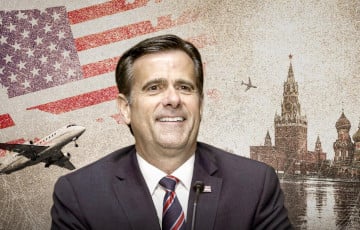
Why Did the CIA Director Fly to Moscow?
John Ratcliffe’s unannounced visit to Moscow is an extraordinary event—especially when neither side has officially commented on it. UNIAN has learned what lies behind this visit.
On Tuesday, August 25, a U.S. military transport aircraft, a Boeing C-17—which is used to transport military personnel, equipment, and cargo, and can also be deployed for government and special missions.
This was no ordinary event. It evidently caught people’s attention.
Official responses to media inquiries about this have sparked even greater curiosity. For instance, the Pentagon, the White House, and the U.S. State Department refused to provide information about the cargo or passengers on board. Meanwhile, the spokesperson for the Russian dictator Dmitry Peskov stated that there was no information regarding the arrival of a U.S. military aircraft in Moscow.
“No, I don’t have that information,” he said at a briefing, adding that no meetings with representatives of the U.S. administration are scheduled at the Kremlin this week.
It was not until the following day that Peskov, in a comment to The Washington Post that there had been contacts between intelligence agencies and that Putin had been briefed on the results of those contacts.
It was indeed pointless to deny the obvious: for a full day, the American media, citing their own sources, had been reporting that John Ratcliffe, Director of the U.S. Central Intelligence Agency, had flown to Moscow on a military aircraft.
The Old New “Red Lines”
On the one hand, there is nothing secret about the fact that contacts exist between Washington and Moscow, despite the deterioration of political relations and sanctions against Russia due to the war unleashed in Ukraine. If governments are unable to communicate through official channels, other channels—such as those of the intelligence services—remain available for discussing a wide range of issues.
On the other hand, this visit by the head of the U.S. intelligence agency to Russia is the first since November 2021. At that time, Ratcliffe’s predecessor William Burns traveled to Moscow, attempting to convey to the Kremlin a warning about the consequences for Russia should a full-scale war break out. After all, U.S. intelligence had information that Russia was preparing for an escalation.
At that time, Moscow disregarded the warnings: the talks did not stop the aggression, and in February 2022, Russia crossed the established “red lines.” So the current visit by the CIA director to Moscow has also sparked a wave of speculation about what might be behind such a visit.
According to Igor Popov, a political scientist and president of the “Politika” think tank, the parallel between the CIA director’s visit to Moscow five years ago and the current one is quite telling. He recalls that in July 2023, Newsweek, citing U.S. intelligence officials, noted: Burns’ mission, although it failed to persuade the Kremlin to abandon the invasion, allowed Washington and Moscow to understand each other’s “red lines” and establish a kind of unwritten set of rules of the road.
And now, he says, history may be repeating itself—not in the details, but in the logic itself: “CIA directors are sent to Moscow not to sign political agreements, but when two nuclear powers need to define, without public diplomacy, the limits of what is acceptable: what will be considered an escalation, what red lines exist, and what actions by the other side will trigger a response.”
There are plenty of topics for discussion; as for the outcome—we’ll see
“For the sake of this visit, Putin canceled some event ‘with hundreds of guests.’” And Washington asked Kyiv not to attack the Russian capital between August 23 and 26,” notes political analyst and Russia expert Igor Tyshkevich. “A visit of this nature is an extraordinary event.”
According to the expert, the prevailing view in the Ukrainian media is that this visit is directly linked to the Russian-Ukrainian war. But the reality is somewhat different.
“The CIA director is a specific problem that requires swift solutions. Therefore, this is definitely not about a ‘peace plan’ to freeze the war—such topics are discussed by other people,” notes Tyshkevich.
In his view, there are at least six topics that Retcliffe and Putin could have discussed (although Peskov denies that this meeting took place). In particular, these could include a prisoner exchange—the U.S. has a list of its citizens it wants to secure from Russian prisons; security issues in the Baltic states (Russia’s efforts to extend the front lines of conflict into European countries); the situation in Iran and the issue of Iranian nuclear materials; the Arctic and maritime security (as well as the issue of Svalbard); a ceasefire in the Black Sea; and a package of measures to freeze the war in Ukraine.
“The last one is the least likely,” he says.
For his part, American political reporter and editor of The Insider Michael Weiss is convinced that, for example, the issue of prisoner exchanges was unlikely to have been on the agenda. Since, according to him, the CIA director is not needed for such agreements.
Weiss believes that Ratcliffe visited Moscow to force Putin to refrain from escalating Russian actions against Europe and NATO.
“This is linked to U.S. intelligence shared with the Poles, the Balts, and the Scandinavians, and comes amid a noticeable increase in likely GRU sabotage operations and Russian drone activity in Germany, Bulgaria, and Romania,” he suggested.
In addition, according to Weiss, Retcliffe discussed in Moscow a mutual cessation of attacks on the energy infrastructure and ports of Ukraine and Russia, as well as a possible ceasefire in the Sumy and Kharkiv regions, as steps toward overall de-escalation, along with the prospects for ending the war.
Peace for Trump
According to Ukrainian scholar and diplomat Serhiy Korsunsky, it is also worth noting that the visit by a high-ranking representative of the U.S. Administration to Moscow took place two months before the midterm elections. Therefore, it is likely linked to the difficult situation facing the Republicans.
“They need victories and an end to the war (if we don’t count the trade war with Canada, there are two wars, and both involve Russia). So, most likely, they discussed the conditions for declaring success in U.S. President Donald Trump’s peacemaking efforts,” he believes.
According to the diplomat, the context may be as follows: “You don’t want President Trump to have problems, do you? Do you expect a Democratic president to be more receptive to Russia? So—no escalation; we’re looking for at least some kind of truce, and then, after the election, we’ll see. Maybe everyone will be happy, and the war will end altogether.”
Consequently, according to Sergey Korsunsky, it’s just a matter of price.
Political analyst Alexander Kraev, director of the “North America” program at the Ukrainian research group “Ukrainian Prism,” partly agrees with this view Alexander Kraev: “It’s important to Trump that an agreement be signed—one that bears his name and bears his signature. And Russia is currently in a state where it can be asked a direct question: ‘How quickly are you willing to reach an agreement before things get worse?.”
In his view, the Americans, through the CIA director, most likely set conditions for Moscow: specific, clear deadlines by which the Russians must make concessions and take action so that an agreement with Ukraine would appear more realistic.
“The U.S. cannot currently stop Ukraine’s advance (in the sense of continued strikes deep into Russia), even if it wanted to... And it is precisely the Americans who want to put pressure on Moscow as quickly as possible so that the Russians will at least sign something with us. In other words, the situation is such that right now Trump has the opportunity to put more pressure on Moscow,” notes Alexander Kraev.
However, according to him, Ukraine should not count on security guarantees or additional missiles in this context. He points out that Donald Trump doesn’t care who wins, in what condition, or how they emerge from this war.
“What matters to Trump is that an agreement be signed,” the expert adds.
Finally, the political scientist urges people not to be alarmed by such contacts between Washington and Moscow. We must understand that, through their intelligence agency representatives, the Americans are not speaking with those who are dear to them or necessary to them, but with those who pose a threat.
“In other words, if Ratcliffe is the only high-ranking American official who has actually spoken with the Russians, then it was a fairly substantive—but by no means friendly—visit,” he asserts.

Bank's name: Bank Millennium S.A.
Address: ul. Stanislawa Zaryna, 2A, 02-593, Warszawa
IBAN: PL97116022020000000216711123
SWIFT: BIGBPLPW
Name of the account holder: Fundacja “KARTA ‘97”
Purpose/title of payment: Donation for statuary aims
You can contact us by the e-mail charter97@gmail.com