"Lukashenko Fears Suffering The Same Fate As Mladić And Karadžić"
1- 29.08.2026, 14:31
The death of the “Bosnian Butcher” in The Hague—a warning to the dictator.
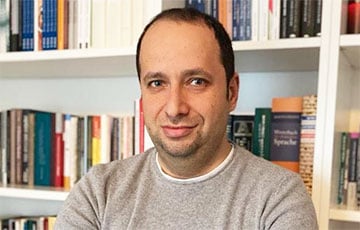
A war criminal, the commander of the Bosnian Serb Army Ratko Mladić. What are the chances of an international trial for those responsible for torture and deaths in Belarus? On the air at “Radio Svaboda”, historian and political scientist Alexander Friedman discusses the issue.
— Ratko Mladić, the former commander of the Bosnian Serb army who was sentenced to life in prison for war crimes, died this week. In 2017, a court found Ratko Mladić guilty of genocide for organizing the 1995 massacre of at least 8,000 Muslims in Srebrenica, Bosnia — the worst crime in Europe since World War II. Against this backdrop, what do you think are the chances of an international trial for those responsible for torture and deaths in Belarus? Are hopes for an international trial of Lukashenko and his regime in vain?
— If we look at the fate of Ratko Mladić, he managed to evade accountability for quite some time. He was in hiding in Serbia. For a certain period, the Serbian authorities either pretended not to know his whereabouts or took virtually no action. For Serbia, this was a serious issue in both foreign and domestic policy. There are plenty of people in Serbia—and there still are to this day—who do not consider Ratko Mladić a war criminal, a man responsible for one of the worst crimes in postwar European history. I am referring to the massacre in Srebrenica, where approximately 8,000 people were killed. There are people who consider Mladić a true hero of Serbia, a man who fought for Serbian interests.
But it is interesting that in Mladić’s case, we are dealing with a man who not only committed crimes but also faced consequences for them. There were various attempts on his part and on the part of his defense to avoid accountability, but Mladić’s fate is well known: he was convicted and died behind bars. True, a very long time passed before he ended up behind bars—almost 15 years.
As for the Belarusian context, I found it very interesting to observe the reaction of Belarusian state propaganda to Mladić’s fate and death. It was very swift. The narratives themselves did not surprise me: they portray Mladić as an outstanding figure. The real question is how quickly they reacted and how much they emphasize that he died behind bars. This shows that the fate of Mladić and people convicted in this way truly concerns the Belarusian authorities. This specter of The Hague has clearly not gone away.
Although at the moment, the chances that anyone in the Belarusian context will stand trial in The Hague are, to put it mildly, very slim. The chances that people like Mladić or Radovan Karadžić, President of the Republika Srpska, who are currently behind bars, would be punished were significantly higher at one time. If only because Serbia was—and remains to this day—interested in European integration and cooperation with the European Union. The Belarusian context is entirely different. But the context can change; the dynamics can change. And the fates of Mladić and Karadžić serve as yet another signal to the Belarusian authorities that, under certain conditions, a situation may arise in which they will have to answer for their actions—including in The Hague.
— One more war criminal remains behind bars: 81-year-old Radovan Karadžić, the first president of the Republika Srpska (a part of Bosnia and Herzegovina). According to Florence Hartman, former press secretary to Carla Del Ponte, the chief prosecutor of the International Criminal Tribunal for the Former Yugoslavia, in 1997, Russia transported Radovan Karadžić to Belarus, where he went into hiding for several months. Now, propagandists in Belarus are expressing sympathy over the death of the war criminal Ratko Mladić. What is Lukashenko’s attitude toward those convicted of war crimes in the former Yugoslavia? Toward Karadžić, Mladić, and Milošević himself? Is this simply business for him—providing asylum, as he did for former Kyrgyz President Kurmanbek Bakiyev? Or is there a certain affinity here?
— I think there is definitely a certain affinity. Back in the day, after Lukashenko was elected president of Belarus, he took a keen interest in events in the Balkans. His well-known visit to Belgrade, his statements on Balkan issues—he followed these events quite closely. I think he’s keeping track of both Milošević’s fate and that of others. Speaking of Milošević—and in Karadžić’s case, we can assume they also met with Lukashenko, since Karadžić was indeed in hiding in Minsk for a certain period of time.
These are people Lukashenko knows and feels sympathy for. And they are people who, in his frame of reference, challenged the West—and lost. Lukashenko also sees himself as someone who has challenged the West. Here, one can recall various examples that he mentions from time to time: Milošević, Gaddafi, Hussein, and so on. These are people for whom he has a soft spot, and he probably reflects, in various contexts, on how to avoid repeating their fate himself.

Bank's name: Bank Millennium S.A.
Address: ul. Stanislawa Zaryna, 2A, 02-593, Warszawa
IBAN: PL97116022020000000216711123
SWIFT: BIGBPLPW
Name of the account holder: Fundacja “KARTA ‘97”
Purpose/title of payment: Donation for statuary aims
You can contact us by the e-mail charter97@gmail.com