

The Russian Central Bank Has Become The World's Largest Seller Of Gold To Fund Putin's Military Budget
3- 8.09.2026, 20:34
- 5,298
Gold is being exported from Russia by the ton.
The large-scale sale of gold bars from its reserves, which the Bank of Russia began in 2026, made it the largest seller of gold among all central banks worldwide, according to The Moscow Times.
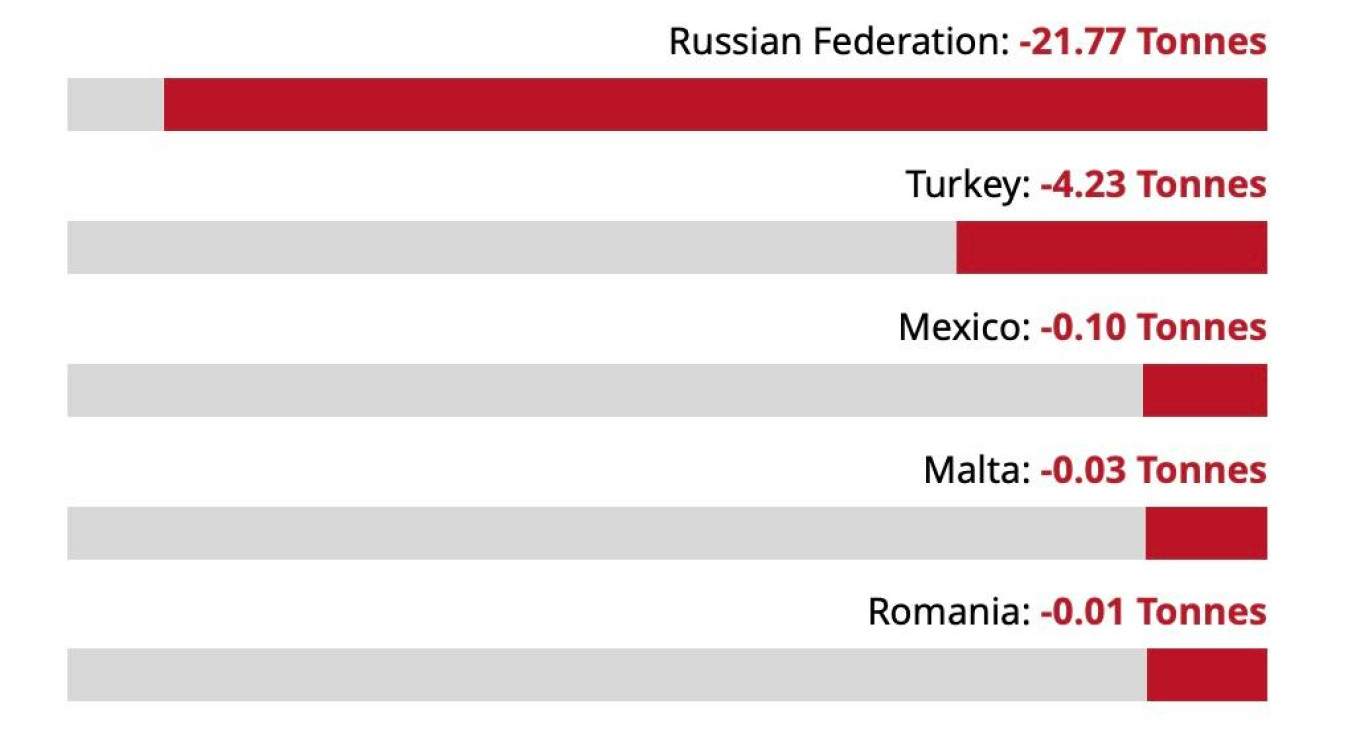
According to the World Gold Council (World Gold Council, WGC), in the second quarter the Central Bank of the Russian Federation sold 21.77 metric tons of gold from its foreign exchange reserves, far outpacing the Central Bank of Turkey, which ranked second in sales with 4.23 metric tons.
Other central banks, if they sold any gold at all, did so in negligible amounts: Mexico sold 0.1 metric tons, Malta sold 0.03 metric tons, and Romania sold 0.01 metric tons, according to WGC data. The largest buyers of gold were the Central Bank of Poland (50.79 metric tons), as well as the central banks of China (32.97 metric tons) and Uzbekistan (16.17 metric tons).
The Russian Central Bank is actively selling gold primarily to “use the proceeds to cover the state budget deficit and the shortage of foreign exchange liquidity,” notes Finam analyst Alexander Potavin. According to its own data, from the beginning of the year through the end of July, the Bank of Russia sold 1.6 million troy ounces from its reserves (49.7 metric tons).
This marked the largest single sale of gold reserves since the 1998 default: at that time, amid the collapse of the GKO government bond pyramid scheme, Russia sold 3.8 million ounces over three months (118 metric tons), according to International Monetary Fund statistics. As of August 1, the Central Bank’s gold reserves had fallen to 73.2 million troy ounces—the lowest level since 2020.
The fact that the Kremlin has begun selling off gold suggests that “they are running out of other liquid assets,” notes Elina Rybakova, an economist at the Peterson Institute for International Economics. In the very first days of the war with Ukraine, the Central Bank lost $300 billion in foreign exchange reserves, which had been held in dollars, euros, and other Western assets and fell under sanctions. Of its foreign exchange reserves, it has only about $100 billion remaining in the form of Chinese yuan.
The Central Bank’s actions regarding gold indicate “growing pressure” related to Russia’s budget deficit and “pressure regarding sources to finance this deficit,” notes Rybakova. According to the Ministry of Finance, the “hole” in the federal treasury amounted to 6.45 trillion rubles from January through July, and 5.7 trillion rubles last year.
However, one should not conclude from the gold sell-off that Russia has “gone bankrupt,” emphasizes Chris Weifer, an analyst at Macro-Advisory: The Central Bank of Russia’s gold reserves are the fifth-largest in the world, and so far they have shrunk by only 2.1%. At the current rate—200,000 to 300,000 ounces per month—it would take about 20 years to sell them all.
The Central Bank will likely continue selling gold, according to Potavin: at the beginning of the year, gold accounted for 48% of Russia’s reserves; now that share has fallen to 41.5%. “Perhaps a level of around 40% or slightly below could serve as a threshold. However, as long as there remains a need to cover a significant budget deficit, the share of gold in reserves may continue to decline,” Potavin said.

Bank's name: Bank Millennium S.A.
Address: ul. Stanislawa Zaryna, 2A, 02-593, Warszawa
IBAN: PL97116022020000000216711123
SWIFT: BIGBPLPW
Name of the account holder: Fundacja “KARTA ‘97”
Purpose/title of payment: Donation for statuary aims
You can contact us by the e-mail charter97@gmail.com