

A Ukrainian Pilot Explained Why Two Russian Planes Collided
2- 8.09.2026, 17:36
- 21,220
The Russian aviation industry has begun to face serious problems.
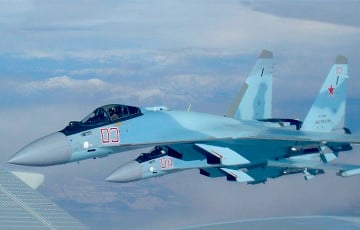
In recent days, Russia has suffered several losses to its combat aircraft. In the Kursk region, two Su-35S fighter jets collided. At the airbase in Taganrog Ukrainian drones destroyed a Mi-8 helicopter and damaged a Mi-35. The day before, GUR operators also struck a Russian aircraft, presumably a Su-24, in occupied Crimea.
What could have happened to the two Su-35Ss in the Kursk region? Why did the Russian fighter jets collide in the air?
The website Charter97.org discussed this with Colonel (Res.) of the Ukrainian Armed Forces, military expert, and flight instructor Roman Svitan:
— Most likely, it was a flight in formation. The pilots were practicing formation flying, and one of the Russians made what is known as a piloting error. I think so because that’s the most common cause. When two aircraft of the same type collide in the air, it most often happens precisely during a formation flight.
The fact is that this is a very complex type of flight. The interval and distance between the aircraft are very small. This is especially true when practicing complex forms of formation flying, such as mock dogfights. While performing certain flight maneuvers, visual contact can be lost and then reestablished. For example, the planes entered a cloud bank; the follower lost sight of the leader and began searching for him without reporting it.
Such moments ultimately lead to one plane colliding with another. Very often, the pilot of the lead aircraft is killed. The wingman keeps an eye on the lead, but the lead does not visually monitor the wingman. As a result, the wingman may collide with the lead. In such cases, both aircraft can be lost, and the pilots may be killed. I think this is exactly the kind of situation we’re seeing right now.
— What could have led to such a mistake: a lack of experience on the part of the pilots or fatigue?
— It’s clear that a lot depends on experience. That’s one hundred percent true. But the main reason, after all, lies in the complexity of formation flight itself. It is very complex in and of itself.
Two aircraft are flying side by side at transonic speeds. Just imagine that. Let’s say the standard interval and distance are 50 to 70: 70 meters is the distance, and 50 meters is the interval. But this interval can decrease, especially when flying through clouds. In poor visibility, it’s deliberately reduced. The aircraft fly too close to one another, the pilots lose control, and one plane collides with another. Formation flying is the most complex type of flight. Therefore, such flights are among the most accident-prone. This applies to combat, training, and evaluation flights.
That is why I believe the main cause lies precisely in this: an error in piloting technique during a formation flight. That is the correct term for it.
But for now, what happened remains a mystery. This is just my analytical assessment, so to speak. No one knows the real cause yet.
— Recently, Ukraine has destroyed or damaged several Russian aircraft and helicopters at once. What accounts for these successes by the Ukrainian Armed Forces in striking key targets at Russian airfields?
— First and foremost, the Ukrainian Armed Forces are carrying out the mission of achieving air superiority. To do this, of course, it is necessary to destroy Russian radar systems—that is, the radars of the Russian Federation’s electronic warfare units. These are primarily located at airfields.
Airfields are the primary locations for anti-aircraft missile systems and surveillance radars belonging to the Russian Federation’s electronic warfare forces. Naturally, targeting an airfield to destroy electronic warfare equipment also makes it possible to take out Russian aircraft stationed there. Our forces are not necessarily specifically hunting for them. This may be a consequence of carrying out the primary mission of destroying the airfield’s infrastructure.
Let’s say there is army aviation stationed at these airfields. It uses virtually all of these facilities as tactical staging airfields. Army aviation consists primarily of helicopters. There are also aircraft there that sometimes haven’t taken to the air for decades—especially old Soviet aircraft like the Su-24.
Why? Because they can sit at airfields for years in so-called “Aurora” mode—that is, used as sources of spare parts. That happens, too. No one even provides air cover for these aircraft, which is why they come under attack.
The main types of Russian tactical aircraft at airfields within striking range are, to put it mildly, rarely encountered. When was the last time you heard of a Su-30, Su-34, or Su-35 being destroyed at such an airfield? These are the main types of Russian combat aircraft.
They have, after all, been moved beyond the operational range of our tactical drones—that is, beyond the 300-kilometer zone. That’s where the main airfields of the Russian tactical aviation are located. We currently have few capabilities to reach them in real time. By “real time,” I mean direct control, where a drone operator can select a specific target right at the airfield. We do not yet have such capabilities, but they will emerge. The geographic scope of our strikes will undoubtedly expand, and this is already yielding certain benefits. We can see this very clearly. The benefit lies in the fact that new opportunities are opening up for us.
Some of our technological breakthroughs are particularly important. It is precisely these that give us confidence that, over time, we will be able to go even further and begin destroying the main types of Russian aircraft at airfields—first and foremost the Su-34 and Su-35. For now, the Russians are doing a good job of handling this task themselves and are destroying their own aircraft during formation flights.
— You said that the main aircraft of the Russian tactical aviation have been moved beyond the 300-kilometer zone. How does the need to take off from more distant airfields affect the state of the Russian Air Force and its ability to carry out combat missions?
— The fact is that the combat mission itself does not change due to the remoteness of the airfields. Let’s say, for example, the mission is to drop 200 KAB bombs per day. To carry out this mission, the Russians allocate the necessary resources: flight-hours, aircraft, and pilots who will be deployed.
After we used our drones to drive the Russian air force beyond the 300-kilometer zone, the situation changed. Although at first, it was ATACMS missiles that began driving the Russian air force back. When ATACMS missiles with a range of up to 300 kilometers began striking Russian airfields, the Russians moved their aircraft more than 300 kilometers away. This exactly doubled the number of resources the Russian Air Force has to deploy. They have to use twice as many aircraft and flight crews. Consequently, the rate of consumption of aircraft resources doubles.
Aircraft resources are not infinite. Let’s say an aircraft has a nominal service life of 10,000 flight hours. Once this service life is exhausted, the aircraft is dismantled and remains at the airfield. It’s roughly the same situation as with that Su-24 that was “written off.” It can sit there for decades until someone removes a spare part from it for another aircraft.
That’s why this approach is also beneficial for us. The Russians need twice as many aircraft, pilots, aviation resources, and fuel to accomplish the same task.

Bank's name: Bank Millennium S.A.
Address: ul. Stanislawa Zaryna, 2A, 02-593, Warszawa
IBAN: PL97116022020000000216711123
SWIFT: BIGBPLPW
Name of the account holder: Fundacja “KARTA ‘97”
Purpose/title of payment: Donation for statuary aims
You can contact us by the e-mail charter97@gmail.com