
EU and US present united front against regime of Lukashenka
100- 18.11.2011, 10:35
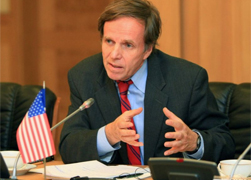
The US Assistant Secretary of State for Democracy, Human Rights, and Labor, Michael H. Posner, had a meeting with Natalia Radzina, the editor of charter97.org website.
The meeting took place on November 17 in Washington during Natallia Radzina’s visit to the US on invitation of the Committee to Protect Journalists.
The charter97.org editor came to the US to accept the award of the Committee to Protect Journalists for courage showed under extreme conditions. The 2011 award was given to journalists from Belarus, Pakistan, Mexico and Bahrain.
Michael Posner, the Assistant Secretary of State for Democracy, Human Rights, and Labor, met with the awardees and asked them questions.
Talking about the situation in Belarus, Michael Posner noted that Vilnius would host a meeting of the OSCE Ministerial Council in December. The Assistant Secretary of State asked what policy the EU and the US should conduct towards to Belarusian regime.
Natallia Radzina thinks that the US should persuade its European partners to adhere to a principled and tough position in relation to the Belarusian dictatorship.
“The US has the right moral stance on the Belarusian dictatorship. Only economic sanctions can lead to real changes in Belarus. It’s necessary to understand that the regime of Lukashenka poses a threat to Europe and the rest of the world by selling weapons to rogue states. At the same time, the regime is an economic bankrupt now and weak as never before. In this situation Europe should not increase trade with the dictatorship, but impose embargo on Belarusian oil products and potash fertilizers. Income from these sales goes to Lukashenka’s family and respectively to maintain the repressive machine that suppresses any protest moods in Belarus.
The US should do their best to persuade the European Union to impose targeted economic sanctions. Unfortunately, EU officials do not have a strategy to improve the situation in Belarus,” the journalist noted.
Radzina thinks what European leaders say is just empty rhetoric and excuses not to take particular actions while 15 Belarusian political prisoners, among them two former presidential candidates Andrei Sannikov and Mikalai Statkevich, are still in prisons.
The journalist told the assistant secretary about the situation of Andrei Sannikov, who faced tortures and ill-treatment in prison. The political prisoner is being transferred from one prison to another. His current whereabouts are unknown now. Radzina also talked about another political prisoner Zmitser Bandarenka, the coordinator of European Belarus civil campaign, who may become disabled for the rest of his life.
“When you meet European politicians and ask them why they do not take a political course towards Belarus in the way the United States does, they answer the US does not have the interests in Belarus the EU has, so it’s easier for America to apply sanctions. Indeed, statistics shows that Belarus’s trade turnover with the EU increased 76% from January till September. It means that the EU condemned the harsh suppression the December 19 demonstration, but continues to trade with the dictatorship,” the Belarusian journalist said.
On November 17, Freedom House organized a round table discussion on Washington on the situation in Belarus with participation of Natallia Radzina, Freedom House president David Kramer, senior policy analyst Center for European Policy Analysis Peter Doran, Freedom House Director for Eurasia Susan Corke and Advisor at US Helsinki Commission Orest Deychakiwsky.
David Kramer welcomed the Belarusian journalist, whom he called a “real hero”, in Freedom House headquarters in Washington and asked her to share her views on the ways to change the situation in Belarus.
Natallia Radzina noted that the report “Democratic Change in Belarus: A Framework for Action” recently released by the Center for European Policy Analysis (CEPA) represents the best strategy that takes into account possibilities and prospects for changing the situation in Belarus.
The report contains recommendations to both western politicians and Belarusian opposition and civil society on the actions that can change power in the country. The report consistently advances an idea that reforms in Belarus are possible only after Alyaksandr Lukashenka quits and eliminates a possibility of a dialogue with the current authorities as a way to democratic reforms and market economy.
David Kramer said the common position of the US and the UE would be a key point in applying pressure on the Belarusian regime.
Kramer pointed the necessity of serious measures and increasing pressure on the regime of Lukashenka. He noted that the EU sanctions imposed in July 2011 were not enough.
Kramer emphasized the importance of the joint stance of the US and the EU on issuing Belarus an $8bn loan from the International Monetary Fund.
Kramer said he and his colleagues were concerned after two IMF visits to Belarus in June and October 2011. But the official report of the IMF after the October visit gave a clear understanding that the regime of Lukashenka would not get a loan in the nearest time.
Orest Deychakiwsky, the advisor at the US Helsinki Commission, reminded that some months ago a group of six American senators sent an open letter to US Treasury Secretary Timothy Geithner stating that the United States should urge the IMF not to allocate a loan to the regime of Lukashenka.
Geithner gave to understand in his reply that the US would not support granting a loan, Deychakiwsky said.