Grynkevich Responded To Lukashenko
- Valery Karbalevich
- 14.10.2026, 13:21
- 1,576
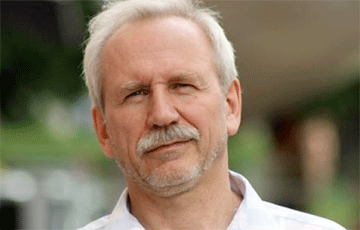
NATO approved the action plan.
NATO's new strategy indicates that, in the event of a war with Russia, military facilities on Belarusian territory could also come under fire. Despite Lukashenko’s peace-loving rhetoric, his military alliance with Moscow poses an ever-greater danger to the country.
A Questionable Image
Recently, Belarusian state propaganda has been making great efforts to reinforce the country’s image as an island of peace, security, and tranquility. It is claimed that a peaceful sky amid global military upheavals is the country’s current image. Statements by Belarusian officials are made precisely in this vein. Recently, Foreign Minister Maksim Ryzhenkov declared the country’s readiness to restore military communication channels with NATO, return to verification mechanisms, early warning systems, and other measures to ensure transparency in the military sphere.
At the same time, Alexander Lukashenko is being portrayed as a guarantor of peace. There are even attempts to rhetorically distance the country from Russia. During a meeting in Minsk with the heads of government of the EAEU countries on October 2, Lukashenko acknowledged that Belarus’s position on the war in Ukraine does not fully coincide with Russia’s:
“I told President Putin this openly: I have my own understanding of certain aspects of the conflict in Ukraine.”
Official Minsk is also demonstrating its peacemaking efforts to achieve a ceasefire in Russia’s war against Ukraine. Lukashenko is offering himself as a mediator, calling for peace talks to be held in the Belarusian capital.
A Target for an Alliance with Russia
However, a speech by the Supreme Commander of NATO Forces in Europe Alexus Grinkevich at the Warsaw Security Forum on October 12 should give us pause for thought. According to him, three months ago NATO approved a plan of action in the event of Russian aggression against European members of the North Atlantic Alliance.
According to The Wall Street Journal, this plan calls for long-range missile strikes against Russian command centers and air defense facilities in the Kaliningrad region, the St. Petersburg region, and Belarus.
The logic of NATO’s leadership is clear. It is difficult to imagine a Russian attack on Poland and the Baltic states without using Belarusian territory, since Belarus borders all of these countries. Russia has already used Belarusian territory to invade Ukraine in 2022, so such a scenario is taken seriously in the region.
Grinkevich did not reveal any major military secret. In Western military circles since the 1990s, Belarus has been viewed primarily as a military ally of Russia.
Incidentally, this is exactly how Belarus was viewed in the Kremlin as well. It is well known that, ever since the time of Boris Yeltsin, Russian security officials have been Lukashenko’s most reliable lobbyists in Russia. From the very inception of the so-called Union State, the military component has played a very important role in the process of Belarusian-Russian integration.
Although in the 2010s, especially after Russia’s annexation of Crimea, Lukashenko tried to avoid close military cooperation with Russia, opposing the establishment of a full-fledged Russian military base in Belarus, he stated that this was impractical and that any such base should be built farther from the borders with NATO member states so that it would not be destroyed.
A Close Military Alliance After 2020
But 2020—and especially the start of Russia’s war against Ukraine—radically changed everything. The attack on Ukrainian territory originated from Belarusian territory. Russia continued to shell Ukraine from there until the fall of 2022. International organizations condemned Belarus’s participation in Russia’s aggression against Ukraine, including the use of Belarusian territory for the Russian invasion.
Overall, Belarus and the Russian Federation have concluded about four dozen international agreements aimed at coordinating joint actions in the military sphere. More than 40 agreements govern military-technical cooperation between the two states. A joint Regional Force Group and a Unified Regional Air Defense System are in operation. Joint military exercises are held annually. There are two Russian military facilities located on Belarusian territory: the “Volga” radar station (“Baranovichi”) and the communications hub of the 43rd Naval Fleet (“Vileika”).
On March 2, 2021, the defense ministries of the two countries signed a five-year strategic partnership program. An agreement was also reached to establish three joint military training centers. In November 2021, the Military Doctrine of the Union State was updated.
Mutual obligations to support an ally in the event of external aggression are enshrined in a number of documents adopted and signed by Belarus and Russia within the framework of the Union State. In addition, such obligations are contained in agreements within the framework of the CSTO. In 2024, Minsk and Moscow signed a Treaty on Mutual Security Guarantees.
Amid a great deal of propaganda hype, they announced the deployment of Russian tactical nuclear weapons and the “Oreshnik” missile system on Belarusian territory.
All of this is taking place against the backdrop of the escalation of Russia’s war against Ukraine and its confrontation with Europe. Moscow is increasingly threatening European countries with nuclear weapons. Russia is raising the stakes and fueling tensions.
Words Do Not Match Deeds
The Belarusian leadership is trying to maneuver in these circumstances. On the one hand, there are endless military exercises, combat readiness checks of various units, training of reservists as part of territorial defense, and so on. And all of this is taking place against the backdrop of repeated Russian propaganda narratives about an aggressive West.
On the other hand, Lukashenko constantly assures everyone of his peace-loving nature. At a meeting on October 13, he stated:
“We are preparing for war in order to avoid it. We have no intention of attacking anyone, yet recently our Western ‘friends’ have launched a media campaign claiming that Russia will attack the Baltic states—and possibly Poland—from Belarusian territory and in conjunction with Belarus.”
However, Russia’s Western neighbors look not at words, but at actions. More and more evidence is emerging that Russia is waging a “hybrid war” against Europe, and that Belarus is aiding it in this effort. This is evidenced, in particular, by Latvia’s new accusations against Belarus regarding an incident on their shared border. On October 13, Lukashenko rejected accusations that an armed group had infiltrated from Belarusian territory.
As military and political tensions in Eastern Europe escalate, Belarus’s autonomy as an independent geopolitical actor is diminishing. It is viewed as a single entity with Russia. And Lukashenko, by speaking of “our common homeland from Brest to Vladivostok,” only reinforces such perceptions. Therefore, in the event of Russian aggression against NATO, military facilities on Belarusian territory could become targets of retaliatory strikes.
As a result of Lukashenko’s policies, Belarus has become a hostage to Russia’s aggressive imperial ambitions.
Valery Karbalevich, “Radio Svaboda”

Bank's name: Bank Millennium S.A.
Address: ul. Stanislawa Zaryna, 2A, 02-593, Warszawa
IBAN: PL97116022020000000216711123
SWIFT: BIGBPLPW
Name of the account holder: Fundacja “KARTA ‘97”
Purpose/title of payment: Donation for statuary aims
You can contact us by the e-mail charter97@gmail.com