


Just A Year Ago, This Seemed Like Science Fiction
- Konstantin Sonin
- 2.11.2026, 9:50
- 3,976

It all boils down to two very basic facts.
Something that, in my opinion, has never existed in the history of American elections up to 2026—is such an abundance of resources where you can view calculations based on all existing polls, all kinds of aggregated indicators (synthetic averages, simple averages, averages incorporating regression results, etc.), and projections for the outcomes of hundreds of congressional races and various state-level offices, the results of which will begin to be tallied on Tuesday. I recommend the Silver Bulletin, PollVault/RCP, the NYT, but there are also many other very good sources (Morris’s 50+1, DecisionDesk, the hubs on CNN and Fox, etc.).
Very briefly, it all boils down to two fundamental facts:
1) It has essentially been known since November 5, 2024, that the Democrats would take the House of Representatives. The Republicans’ margin of victory in that election was so narrow that a Democratic loss in the midterm elections would have been a rare exception. Right now, no forecaster is giving the Democrats less than a 90–95% chance of winning; it probably couldn’t be any higher.
2) The Democrats are more likely to win a majority in the Senate than the Republicans are to retain it. Just a year ago, this seemed like a fantasy—to achieve this, the Democrats would need to win in states where Trump’s lead over Harris in 2024 was more than 10%. But the Democrats have nominated strong candidates (Cooper, Brown, and Peltola are top-tier candidates); some have proven themselves to be excellent candidates (Talarico hasn’t made a single “self-inflicted mistake” in six months); in some places, the Republicans have fielded weak candidates (Paxton, Marshall, Graham) + President Trump is at record lows in popularity. The war with Iran that he started, along with the high gas and diesel prices caused by that war, have made him and the entire Republican brand toxic in 2026.
In the Senate, the likelihood of a Democratic victory is high, but not guaranteed. Nate Silver gives them a 75–80% probability—slightly higher than what he gave Hillary Clinton in 2016, when Trump won.
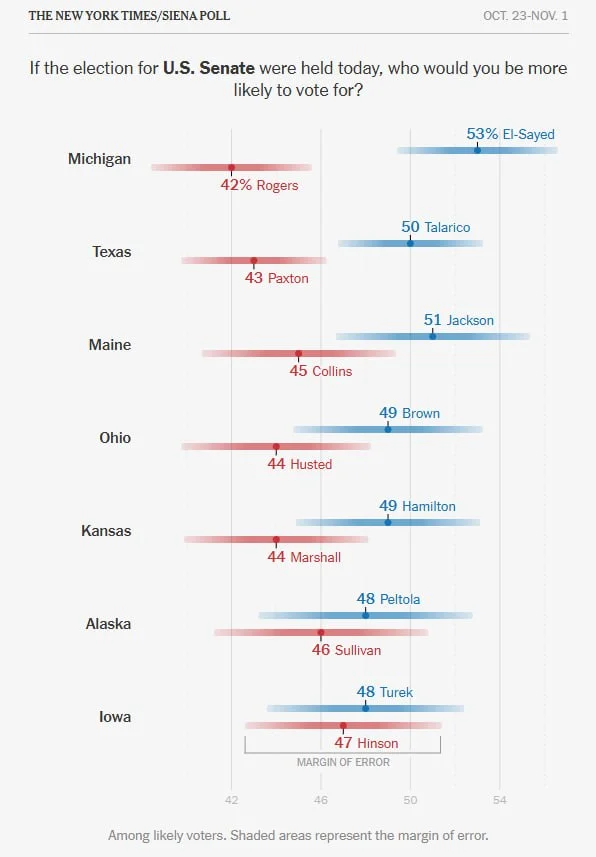
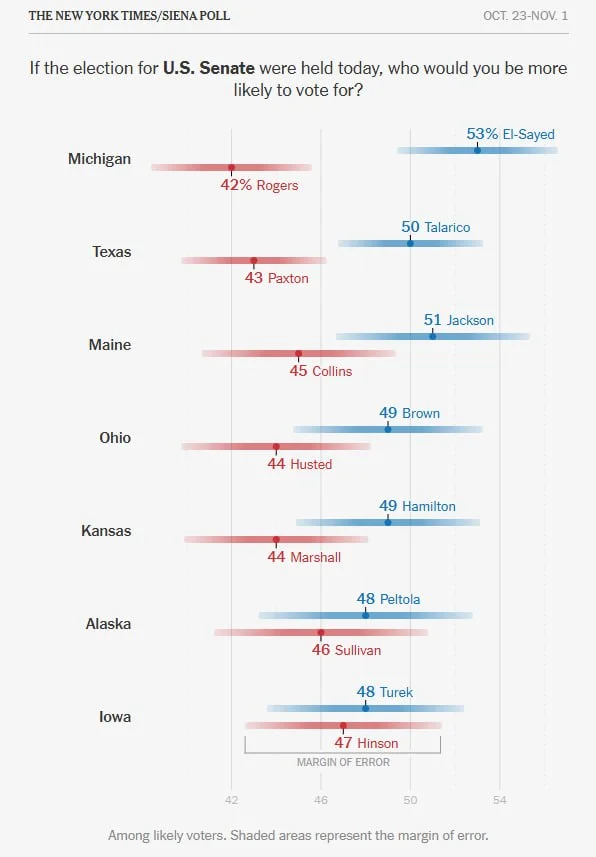
To illustrate, here is Silver’s forecast for November 1, aggregated by individual races, and the results of the latest pre-election NYT/Siena poll in key states.
This is just one poll (the aggregate includes hundreds of polls), but it is of high quality. Roughly speaking, it’s important to remember that a margin of error of 2–3% in recent polls is normal; 4–5% happens occasionally (in recent decades, for example, in 2020); and 8–10% has not happened yet.
Konstantin Sonin, Telegram

Bank's name: Bank Millennium S.A.
Address: ul. Stanislawa Zaryna, 2A, 02-593, Warszawa
IBAN: PL97116022020000000216711123
SWIFT: BIGBPLPW
Name of the account holder: Fundacja “KARTA ‘97”
Purpose/title of payment: Donation for statuary aims
You can contact us by the e-mail charter97@gmail.com