


A Z-blogger Is Impressed By Ukraine's Missile Strike On A Factory In Russia
2- 28.06.2026, 20:09
- 2,790
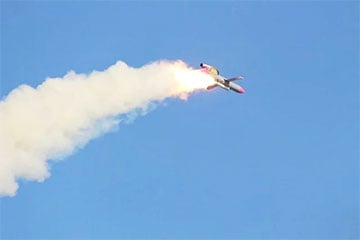
The "Flamingos" have arrived in Volgograd.
Z-blogger Maksim Kalashnikov acknowledged the existence of huge “blind spots” in Russia’s air defense system following the overflight of a group of Ukrainian “Flamingo” missiles and the strike on Volgograd, writes "Dialog".
On his Telegram channel, he wrote that the cruise missile—which he describes as an easier target than the American “Tomahawk”—was able to reach the Volga River. For Russia’s pro-military camp, this was an alarming admission: the skies over Russia are far from as reliably protected as propaganda has claimed for years.
“The ‘Flamingo’ flew over Stalingrad.” In other words, a cruise missile—which is far simpler than the ‘Tomahawk’—reached the Volga. Can you imagine the size of the Russian air defense system’s ‘blind spots’? There are no airborne radars capable of detecting cruise missiles from a distance (ground-based radars can’t see very far). There are no air interceptors (in the USSR, MiG-31Ms were supposed to hunt down cruise missiles). It’s easy to imagine what awaits us in the event of similarly massive cruise missile attacks by the U.S., such as those on Iraq in 1991 or on Serbia in 1999. “And what if British and European ‘Storm Shadows,’ as well as ‘Scalps’ and ‘Tauruses,’ are added to the American cruise missiles?” Kalashnikov wrote.
According to him, the problem lies not only in isolated failures but also in the detection and interception system itself. He claims that Russian forces lack airborne radars capable of detecting cruise missiles in advance, and that the capabilities of ground-based radars are limited.
Western and independent military experts also assess the Russian air defense system as overburdened and riddled with serious gaps, which Ukraine is successfully exploiting by launching coordinated strikes with drones and missiles.
According to analysts at the Institute for the Study of War (ISW) and CNN journalists, the Ukrainian Armed Forces’ successful deep strikes, including those on the Moscow Oil Refinery in Kapotna, have demonstrated the impossibility of creating a continuous protective shield over the entire territory of Russia and its numerous industrial facilities.
Experts note that Ukraine’s long-standing strategy of destroying Russian radar stations and launchers has forced Moscow to redeploy air defense systems to the front lines and the capital, leaving other regions of the country without sufficient protection.

Bank's name: Bank Millennium S.A.
Address: ul. Stanislawa Zaryna, 2A, 02-593, Warszawa
IBAN: PL97116022020000000216711123
SWIFT: BIGBPLPW
Name of the account holder: Fundacja “KARTA ‘97”
Purpose/title of payment: Donation for statuary aims
You can contact us by the e-mail charter97@gmail.com