

Russian Aircraft Have Been Banned From Flying In Rain, Heat, And Cold
4- 10.07.2026, 11:06
- 1,832
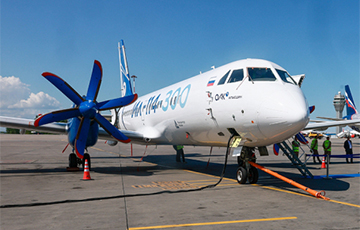
The new "Il" can only fly at temperatures ranging from -9 to +25 degrees.
Rosaviatsiya has issued a certificate to the new Russian aircraft, the modernized Il-114-300, with significant operational restrictions. For example, the aircraft can currently only operate at temperatures ranging from -9 to +25 degrees Celsius. The new Il cannot be operated during thunderstorms or icing conditions, nor on wet or contaminated runways.
Rosaviatsiya issued the certificate, but with significant operational restrictions, according to "Vedomosti".
For now, the aircraft can only operate at temperatures ranging from minus 9 to plus 25 degrees. The previous version, the Il-114-100, had an approved operating range of minus 30 to plus 45 degrees. The new Il-114-300 cannot be operated during thunderstorms or icing conditions, nor on wet or contaminated runways.
At the same time, it was expected that the aircraft would take over some of the regional routes in Russia’s Arctic zone.
However, this does not mean that the aircraft is not adapted to typical Russian conditions: issuing a certificate with restrictions is standard practice, explains Roman Gusarov, editor-in-chief of the Avia.ru portal: “The Il-114-300 is a new Russian turboprop regional aircraft, and it is designed to carry 60+ passengers over short distances—1,000–2,000 kilometers. And, generally speaking, it will fly between regional centers.
As for the initial basic civil aviation certificate: it is standard practice in global civil aviation to issue a basic certificate with significant restrictions. There may be restrictions on operating temperature, for example, in high-altitude areas, and so on. Why is this the case? Because in aviation, let’s just say, certifying or validating such characteristics requires a considerable amount of time and numerous tests, specifically under specific conditions.
For example, to confirm operation at low temperatures, you must at least wait for those low temperatures to occur, fly to that region—somewhere in Yakutia, for instance—during the winter, and conduct the certification program there to demonstrate that the aircraft can fly properly and will be reliable and safe. It’s summer now, and, of course, there’s simply no way to verify low temperatures.
“It is precisely for this reason that the basic certificate is issued with restrictions until the aircraft confirms its capability—that is, until it is possible to send it to conditions where it can demonstrate its operational capability, for example, at low temperatures or, conversely, at extremely high temperatures.”
PAO “Il” is responsible for the aircraft’s development; it is part of the United Aircraft Corporation. In a comment to TASS, the company noted that work on the aircraft’s development will continue in parallel with deliveries. “All new aircraft types, after receiving their basic type certificate, undergo additional certification tests to expand their expected operating conditions,” the company explained.
“The aircraft has already completed takeoffs and landings from a dirt airfield, as well as tests under extremely low temperatures in Yakutia, in icing conditions in Arkhangelsk, and for basing and operation at high latitudes. “We conducted tests at temperatures as low as minus 42 degrees,” added Il.
Rostec CEO Sergey Chemezov had stated that production of the Il-114-300 would not begin until 2027. However, in early June, the head of the Ministry of Transport Andrey Nikitin clarified that the first three aircraft are expected to be delivered as early as this year, and that “production capacity will be ramped up” in the future. During its development, the aircraft’s price nearly doubled—to 2.6 billion Russian rubles.

Bank's name: Bank Millennium S.A.
Address: ul. Stanislawa Zaryna, 2A, 02-593, Warszawa
IBAN: PL97116022020000000216711123
SWIFT: BIGBPLPW
Name of the account holder: Fundacja “KARTA ‘97”
Purpose/title of payment: Donation for statuary aims
You can contact us by the e-mail charter97@gmail.com