

"Putin Really Could Be Hanged"
- 13.09.2026, 14:49
- 1,626
A bloody revolution is brewing in Russia.
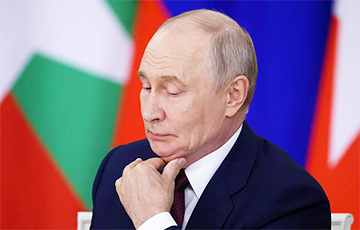
Continuing the war against Ukraine poses a greater threat to Vladimir Putin’s regime in Russia than ending it without achieving even the minimum objective—the complete capture of the Donetsk region. The fact is that Russians are so tired of the war that they will accept any version of “victory” proposed by the regime. At the same time, a protracted war threatens the Kremlin with a bloody revolution, as a result of which Putin could indeed be hanged.
The most logical way for Ukraine to gain an advantage on the battlefield is to rely on advanced military technology. The easiest way to get rid of Putin is to persuade his personal security detail to eliminate him. This opinion was expressed in an exclusive interview OBOZ.UA by a Russian opposition figure recognized as a “foreign agent” in Russia Olga Kurnosova.
– People have been saying for quite some time that ending the war is dangerous for Putin. At the same time, analysts at The Economist have concluded that this poses a threat not only to Putin’s hold on power but also to his personal safety. In your opinion, is the situation really that serious, and does Putin risk paying with his life for the decision to end the war now along the line of demarcation? Or is this solely a threat to his ego as a dictator?
– Let’s start from the beginning. If we’re talking about how dangerous it is for Putin to stop the war today, and how this could be presented to the public, the answer is simple: it’s absolutely not dangerous. Most Russians are so tired of the war that they’ll welcome any explanation with open arms. The main thing is for all of this to end. If, in the process, they call black white and claim that Russia won because, in reality, NATO wanted to tear us apart, but we didn’t fall apart and we won, everyone will say, “Yes, yes, of course, that’s right—that’s exactly how it is.” From this perspective, ending the war poses no particular threat to Putin’s regime.
On the contrary, continuing the war poses a huge threat to Putin’s regime, because today there are no legal forms of protest left, now that even the toothless Yabloko party has been barred from the elections. People have no way to express their views on what is happening, and frustration, outrage, and even hatred continue to build up. All of this can only lead to a very bloody revolution in Russia. And that is when Putin might truly be hanged—even upside down.
In this regard, it is worth recalling the revolutionary events that have occurred throughout history. Very often under harsh dictatorships—as, for example, in Romania during the Ceaușescu era—there were only a matter of days between the moment when power seemed absolutely monolithic and its collapse and the dictator’s removal. In my view, this scenario is far more likely than what Putin fears.
As for the horror scenarios described by *The Economist*, they may well exist in Putin’s twisted imagination, but the question here is who exactly Putin means by the word “they.” Because we remember very well that when Muammar Gaddafi was killed (in October 2011—Ed.), it made an absolutely indelible impression on Putin. Ever since then, he has been terrified that sooner or later the “West”—in the broadest sense—will do exactly the same thing to him.
So in this case, by the word “they,” I wouldn’t so much be referring to some extremely radical “Zetniks” as to that very “generalized West” that Putin fears to the point of paralysis.
– Roughly speaking, is he afraid of the defendant’s bench in The Hague?
– Well, he might not even make it to The Hague. Just recently, Ratko Mladić died; he had been sentenced to life in prison in The Hague—not by the International Criminal Court, but by the International Criminal Tribunal for the Former Yugoslavia. In my view, the Special Tribunal would be a much more effective option in Putin’s case than the International Criminal Court.
– This raises the question: why hasn’t the West, despite having so many levers of influence over Putin’s regime in Russia, used them yet? In this context, Garry Kasparov made an interesting statement in his column for The Telegraph. He provided a list of five measures the Western world should take: ensure full protection of Ukrainian airspace; immediately supply Ukraine with all necessary weapons without delay; instead of imposing new rounds of sanctions, ensure that existing ones are enforced; sever all diplomatic relations with Russia; and immediately confiscate Russian state assets and use them to finance Ukraine’s military efforts. In your opinion, could all of this radically change the situation and force Putin to end the war?
– In my view, there’s a one-item list, and that is to facilitate Putin’s disappearance—whether from the political map of the world or altogether, whichever way it goes. I think there are quite a few ways to get various groups interested—including those within Russia, and even within the Federal Security Service itself. It seems to me that the closer a person is to the dictator—the more they’re part of his personal security detail—the easier it is to do this. And this single-point plan seems to me to be the most effective.
As for the points you listed, there is some movement regarding those assets. Just yesterday (September 10—Ed.) a decision on this matter was adopted by PACE. The question is to what extent the countries where these assets are located are prepared for this. As we can see, Belgium, for example, is resisting this in every way possible and says it will never agree.
What is holding the West back? It’s perfectly clear that the only thing holding the West back is the fact that Putin has his finger on the nuclear button. Of the entire list, the safest option—one that won’t lead to Putin instantly and irrevocably losing his mind, although, in my view, he’s long since lost it—is precisely the issue of assets.
As for everything else… Cutting off diplomatic ties altogether could be interpreted as a declaration of war. Closing airspace? We remember the discussions that took place on this subject at the very beginning of the full-scale war. Another matter is that maximizing arms deliveries, including fighter jets, is also something that can be done.
But, as we understand perfectly well, the problem is that for a long time—just as in the late Soviet Union, during the period of détente— and later, when Russia was, relatively speaking, a reasonable partner, everyone was so eager to avoid spending on arms that, objectively speaking, Western countries now have far fewer weapons than are necessary under current circumstances. And the ramp-up in production isn’t happening as quickly as we’d like. Therefore, there are objective reasons why it is not possible to fully supply Ukraine with weapons quickly. That is why, in my view, it would be much more effective to coordinate efforts as much as possible regarding modern types of weapons.
What do I mean by that? We see that Russia is beginning to outpace Ukraine in terms of jet-powered drones. Therefore, the key is to always maintain a technological edge over Russia. Because Russia, cut off by an iron curtain from modern technological developments, will not be able to outpace the collective West in technology.
Therefore, if modern technologies are deployed on the battlefield, we will see a decisive advantage in the foreseeable future, since, as we know, all major wars have led to a sharp leap forward in killing technology. I apologize for such a harsh word, but it’s the truth. Therefore, whoever achieves a technological advantage first will be the one to win. And Ukraine has every opportunity to do so, since the collective West is on its side.
– You said that most Russians are so tired of the war that they’ll accept any version of Putin’s plan to end it. Nevertheless, we see that Medvedev himself is making statements that can be interpreted as mentally preparing Russians for a protracted war. The emphasis is on the militarization of society. Why? Does this mean that the regime doesn’t understand the processes taking place in society, doesn’t understand what Russians want, and doesn’t understand where this might ultimately lead?
– Regarding Medvedev—it’s important to understand that this is not so much a domestic issue as it is a foreign policy one. It’s very important for Putin to maintain an image in the eyes of the West as not being the most odious figure. It’s very important for him to have someone to contrast himself with. As if to say, “Look, we have some completely crazy people here, but I’m quite willing to negotiate.”
Look, even someone like Trump—for lack of a better example—always falls for this and says that Putin wants peace, deals—he’s always looking for something positive. That’s why it’s extremely important for Putin, in the eyes of the West, to project exactly this image: that he isn’t the main figure who needs to be gotten rid of—the one with whom it’s impossible to reach any agreement at all—and that there are far worse figures out there. There are some die-hard “Zetniks,” like Dmitry Medvedev—who, by the way, is a former president—and Lavrov, who spouts the same nonsense, and so on down the list. Against this backdrop, Putin comes across as the lesser evil.
This is a very important narrative for him, one he’s constantly painting. That’s why, in this sense, I’d view Medvedev exclusively as a media figure and nothing else. That’s the only thing he’s doing right now, and it’s what gets him all sorts of perks from Putin.
– You said that Putin “has long since lost his mind.” Is the whole thing with the polar bears and orcas already a sign of insanity?
– That’s actually a very interesting story. First of all, he told this story based on a video he’d watched—after he’d been harping on to us the whole time that he doesn’t use the internet at all. The question is, who showed it to him? That’s one story.
The second story is also quite amusing. Everyone wondered who he meant by “killer whales” and who he meant by “bears.” Even though a polar bear—specifically a polar bear, not a brown bear—was on the “United Russia” party logo. Take a look at the party’s logo; look at the images from the 2011 campaign—“Not a single vote for the party of crooks and thieves”—there’s exactly the same white bear that was on the “United Russia” party logo. It’s obvious that by the white bear, Putin meant Russia itself, but for some reason many people didn’t catch on right away. That’s why an additional explanation from Pavel Zarubin was needed to replace the orcas with the sharks of capitalism or imperialism.
Why all this nonsense? This often happens with Putin. Back in the Soviet era, there was a show called “In the World of Animals,” hosted by Drozdov, a well-known—I’d say meme-worthy—character. But now, it seems to me, Putin could easily host “In the World of Animals” himself, because something straight out of the “world of animals” is always happening to him.
But we need to understand that, from a PR perspective, it’s always considered very advantageous to use either children or animals. It’s a way of conditioning the audience, because it’s always much more interesting to hear about animals than about people.
And one last thing. Imagine, if he really is that fascinated by “Neuroslops,” maybe even the General Staff, led by Gerasimov, is showing him “Neuroslops”-style offensives by the Russian army—is that why he’s so confident that everything is going well for him?

Bank's name: Bank Millennium S.A.
Address: ul. Stanislawa Zaryna, 2A, 02-593, Warszawa
IBAN: PL97116022020000000216711123
SWIFT: BIGBPLPW
Name of the account holder: Fundacja “KARTA ‘97”
Purpose/title of payment: Donation for statuary aims
You can contact us by the e-mail charter97@gmail.com