


Ukrainian Armed Forces Have Surrounded Russian Troops In Yampol
2- 19.09.2026, 10:59
- 2,628
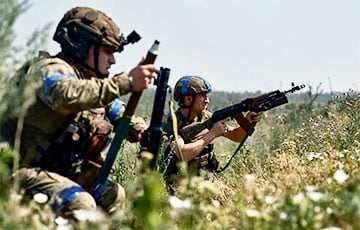
One of the war's decisive battles is about to begin.
An operation is unfolding in the Liman sector that could alter the configuration of the entire front in Donbas.
International journalist and political commentator Ivan Yakovina analyzed why the Ukrainian Armed Forces are bypassing Yampol along the left bank of the Zherebets River, why the defeat of the elite “Rubicon” unit disrupts Russia’s crisis response strategy, and what the panic among Kremlin officials indicates. The website Charter97.org publishes a text version of its analysis:
— The Ukrainian military continues to put pressure on Russian forces in the Lyman direction. The Russians are retreating; in some places, they are simply fleeing. But the Ukrainian Armed Forces themselves carefully conceal both their plans and the locations of their units, so when compiling such reports, one has to rely primarily on Western OSINT analysts working with satellite imagery and on maps from Russian military correspondents—there’s sometimes something interesting to be found there as well.
According to Western sources, Ukrainian troops have crossed the Zherebets River in at least two places—near Nevskoye and near Zarechny. The northern route leads directly into the Luhansk region—the very same region that Putin has “conquered,” it seems, about five times. But I’m more interested in the southern breakthrough, near Zarechny. Because its goal, by all accounts, isn’t simply to penetrate as deep as possible into the rear, but to outflank and encircle from the rear the main Russian base for the entire region—the city of Yampol.
It is precisely from there that Russian offensive strikes have been launched in recent months against Liman and further on toward Svyatogorsk. If the Ukrainian Armed Forces manage to liberate Yampil, the Russians will lose any chance of encircling Slavyansk and Kramatorsk from the north—not just tactically, but entirely. To reverse this, they would have to cross the Zherebets River again, retake Yampil, reestablish a supply base there, fight their way to Liman, then to Svyatogorsk, and finally cross the Seversky Donets River. That’s a task that would take years—if it’s even feasible at all, which I’m not sure it is.
Geography is key here. Yampil is located on the right, western bank of the Zherebets River. If I’m correct about the Ukrainian Armed Forces’ plan, they’re bypassing the city along the left bank to blockade it and cut it off from its main forces. This is also indicated by the fact that, at the same time, the Ukrainian offensive continues along the Seversky Donets from west to east—along the southern flank of Yampol itself. If everything goes according to plan, Ukrainian forces will encircle the city, with two rivers flanking it from the south and north.
This is indirectly confirmed by “Rybár”—arguably the most well-known Russian military correspondent with connections to the Russian Ministry of Defense. He writes that the situation in the Liman sector remains difficult, that Ukrainian units are attacking through forested areas near Dibrova toward Yampil, and that the situation north of the city is also tense. Another alarming development: a report of “a steadily worsening situation.” How much worse? It appears that in the Yampil area, chaos has broken out among the Russians, along with fear of being surrounded; command and control of the troops has largely broken down; some are simply fleeing, while the rest are acting on a “every man for himself” basis. We’ve already seen several times how Russian troops behave when they aren’t the ones on the offensive. That’s why reports are now pouring in from this region about the resumption of “human wave attacks”: commanders are throwing anyone they can get their hands on into the fray in order to push the Ukrainian Armed Forces back from Yampil even a little.
In my view, this is one of the decisive battles of this war. It won’t be easy: the Kremlin will throw all its reserves into it, because it understands that without Yampil, there will be neither the Donbas nor victory.
The consequences of the weakening of Russian forces are already noticeable in neighboring sectors. The same “Rybary” reports that on the northern flank of the Kupiansk sector, the Ukrainians are attacking along the Dvorichnoye–Zapadnoye line. It appears that the 3rd Army Corps, which routed the 20th and 25th Armies near Liman, has eased the situation here as well: as they retreat, the Russians are exposing the flanks of their neighboring units. “Rybary” writes that the enemy is attempting to split the bridgehead west of Oskol in half, while the 68th Motorized Rifle Division is “repelling the assaults.” In reality, it is no longer holding them off: the bridgehead has been split into northern and southern sections, which is even visible on the DeepState map. The Ukrainians are gradually destroying the southern section, which has been cut off from supplies. If the bridgehead is eliminated, the entire Russian strategy in this direction will go down the drain—and this just a few months before the first anniversary of Putin’s grand announcement about the “capture” of Kupyansk, which no one has ever captured.
A separate story is “Rubicon.” The 3rd Army Corps reported that as part of the “Vivaldi” offensive operation it had disabled the command-and-control system of this elite unit of Russian drone operators, destroyed their logistics, ammunition depots, launch sites, and experienced UAV operators. According to the Ukrainian military, the enemy began abandoning their positions, leaving behind their equipment, and the Russian command redeployed the remnants of the unit to another sector. I am inclined to believe this statement: the 3rd Corps usually downplays its achievements rather than exaggerating them.
This is crucial. “Rubicon” served as a lifeline for the Russians—a fire brigade thrown into the most challenging sectors—and it almost always worked. The fighters there are indeed well-equipped, experienced, and tactically proficient, and wherever they appeared, the Ukrainian Armed Forces ran into major problems. But this time, the plan didn’t work: the hunters themselves became the prey—and on a massive scale. Instead of saving the front line, the Russians had to urgently rescue their elite unit. There are no longer any guarantees that the appearance of “Rubicon” in a sector will mean success—and it’s clear that Moscow doesn’t understand what to do about this next.
More precisely, they do have one option, and it’s being discussed more and more often. Mobilization. Putin and his henchmen swear almost every day that it won’t happen. But looking at the front, I get the opposite impression—and it seems I’m not the only one.
Bloomberg, citing documents at its disposal, reports that fear of a mobilization—which Putin might announce after the State Duma elections—has gripped members of the Russian elite as well. Kremlin officials are advising friends and relatives to leave Russia as soon as possible in the coming months and are looking for ways to open accounts abroad. Similarly, according to the agency, staff at military recruitment offices—that is, military registration and enlistment offices—are acting in the same way.
Microbes don’t make mistakes. If this group has started preparing their relatives and acquaintances for mobilization—there will be a mobilization.
There is also other circumstantial evidence. The details of Russia’s budget for the coming year are usually made public in late August or early September. It’s now mid-September, yet the draft remains under strict secrecy; Putin has only commented that defense will be the top priority. I think the secrecy stems from the fact that the document includes funding for mobilization. After all, if the amounts allocated for military registration offices, training, and housing for those mobilized in 2027 were laid out in black and white, anyone unwilling to serve would flee that very day. And there are quite a few such people in Russia.

Bank's name: Bank Millennium S.A.
Address: ul. Stanislawa Zaryna, 2A, 02-593, Warszawa
IBAN: PL97116022020000000216711123
SWIFT: BIGBPLPW
Name of the account holder: Fundacja “KARTA ‘97”
Purpose/title of payment: Donation for statuary aims
You can contact us by the e-mail charter97@gmail.com