
Arkady Moshes: There Is Something Gogolian About Lukashenko's Behavior At The SCO
- 3.09.2026, 8:56
- 3,066
All a dictator can do is curry favor with the powerful.
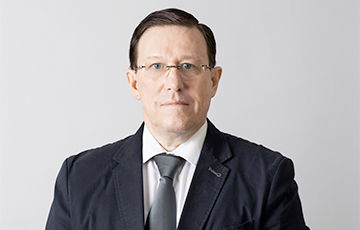
Arkady Moshes , Director of Research Programs on Russia, Eastern Europe, and Eurasia at the Finnish Institute of International Affairs , commented in “Filin”, Arkady Moshes explained how the Belarusian leader’s ambitions did not align with the SCO’s capabilities.
— As we all know, the larger a club is and the easier it is to join, the less prestigious it becomes. The SCO has expanded and become too sluggish; it has reached the limits of its effectiveness,” believes Arkady Moshes, discussing the organization’s latest summit of the organization in Bishkek.
However, it is clear that Lukashenko sees things differently. He believes that the Shanghai Cooperation Organization will open up some enviable prospects for him and his country.
But the expert is convinced that the ruler’s hopes are not destined to come true.
“Actually, there’s something Gogolesque about Lukashenko’s behavior at the SCO,” Arkady Moshes remarks ironically. “Gogol definitely has similar characters.
The kind who, when facing a powerful figure, tries to appear submissive and inconspicuous, but when facing his subordinates, swells to the proportions of an all-powerful ruler.”
By the way, Putin doesn’t have this trait; he uses a different tactic, because, after all, Putin and Lukashenko are in different weight classes. On the surface, he may not seem as imposing, but he certainly operates on the premise that he is the leader of a great power that does not lose in conflicts and seeks partners on equal footing.
There’s a boxing term, “punching above one’s weight”—hitting harder than your weight class would suggest. Well, Putin leads a country that possesses vast resources, and it is capable of punching harder than its weight would suggest.
But Lukashenko leads a country that lacks such potential, so all he can do is curry favor with the powerful and go all out in bullying his subordinates.
His “poking” and this style are very characteristic. He asserts himself by humiliating others.
But then he must realize that there are also those who will assert themselves against his backdrop in the same way. This is exactly what the SCO demonstrated with regard to Lukashenko. He may not like it one bit, but there’s nothing he can do about it.
— Nevertheless, in his speeches, he grandly and emotionally places himself on a par with the leaders of other countries.
— This brings to mind the story of a horse returning from plowing with a fly perched on its back. Another fly asks it, “Where are you from?” and the first one replies, “We were plowing.”
No matter how much Lukashenko tries to place himself on the same level as the leaders of other SCO member states, he will never be their equal. I’m sure he doesn’t like that.
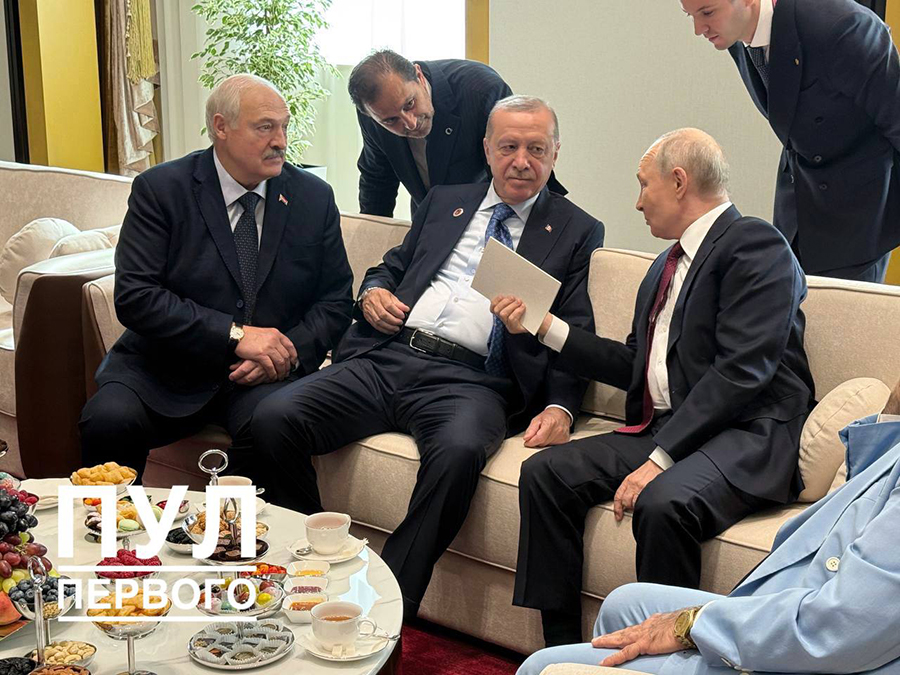
It’s one thing to look modest in a photo sitting behind Erdogan, but there are always these little incidents—remember when Putin made him take a dip in the cold Black Sea this past spring? He probably didn’t want to and didn’t enjoy it, but he’s forced to accept these rules of the game.
On the one hand, he can say “we,” emphasizing his affiliation with a large organization; on the other, he’ll have to agree with everything and fawn over him.
And since he’s such a imposing figure—tall and burly—it’s hard for him to appear small and inconspicuous, especially next to Putin.
And that, too, causes, at the very least, aesthetic discomfort. I think that if he could make himself smaller when meeting with Putin, he would.
— Will Lukashenko’s expectations regarding participation in the SCO be met overall, and what does he actually want, aside from PR?
— For him, the very fact that Belarus—after so many years of being kept waiting in the antechamber—has been admitted to the SCO is undoubtedly an event that he is promoting and will continue to promote domestically.
Hence his bombastic speech, which was sort of about something global and yet about nothing: “Here we are, we have security issues, we must stand together.”
As it seemed to me, the real message was this: “Big guys, you’re supposed to protect me after all—we’re all in this together—so why aren’t you protecting me?”
— A number of experts believe that Lukashenko is also looking to the SCO as a way to at least partially break free from his dependence on the Kremlin.
— I think he really does have that calculation in mind. The SCO is China’s favorite child; it’s not a Russian project. Russia has always felt more at home in the CSTO.
Of course, for Lukashenko, this represents a step up—from the CSTO, a small organization dominated by Russians, to the SCO, a large organization dominated by China.
And Pakistan, by the way, fits into the same context here, since it is close to China. Therefore, maintaining ties with Pakistan is yet another way to underscore his commitment to China and his desire to expand his “sphere of influence” somewhat.
Of course, Lukashenko wants more attention from China to expand his room to maneuver.
But the problem is that while he can certainly generate enough publicity, create a favorable image, and deliver a speech, the SCO is now a very large—and therefore very sluggish—organization.
It brings together countries with a huge number of conflicts among themselves—first and foremost, I’m referring to this triangle: China, India, and Pakistan, which have more differences than they do common ground.
In principle, the SCO has always been primarily an organization for regional economic cooperation; it is not a very active global player.
It is objectively very difficult to formulate a unified position within the organization that would be effective, including in support of any of its members, be it Russia or Belarus.
Incidentally, there are 10 members, followed by dialogue partners—who are quite diverse, ranging from Cambodia to Qatar—and about 15 more countries are observers, while others have merely applied for observer status. It’s impossible to even list them all. What’s there to talk about?
That’s why we shouldn’t expect any results from such participation. Lukashenko has access to this club, and he enjoys it. But that’s all.
— Is it nice to sit on the edge of the couch with Erdogan?
— By the way, if we’re talking not just about the photo but in general, it’s really noticeable how much stronger Erdogan has become and how much weaker everyone else has gotten.
Everything that happened there isn’t even a moment of glory for him; he takes it for granted. He doesn’t see it as an achievement. He’s the leader of a large country, a strong regional power, and that suits him just fine.
He doesn’t need to join the SCO to be strong and respected. And Turkey isn’t a member of the SCO, but merely a dialogue partner.
This underscores the fact that your place in the world determines your place in the organization, not the other way around—where your influence within the organization determines your influence in the world.
This isn’t a paradox; it’s a rule: if you’re big and strong, like Erdogan, everyone will take you seriously anyway. But if you’re small and weak, no matter what organization accepts you, no one will take you seriously as a player anyway.
— You’ve already mentioned Pakistan in the context of China’s ally. Meanwhile, this isn’t the first time Lukashenko has been persistently establishing contacts with that country.
— I think the main factor here is economic. It’s no coincidence that he said their trade volume has dropped by 20%. That’s what he wants to talk about.
Furthermore, the issue of the labor shortage in the Belarusian market remains unresolved. And Lukashenko, apparently, hasn’t given up hope of attracting 150,000 Pakistanis.
However, if something serious were in the works in this regard, it would have been implemented even without the SCO.
But objectively speaking, it’s difficult for Belarus to develop a strategy for promoting exports along the so-called “long arc” because, let’s say, the entire Global South behaves just like in that old joke about a brothel, where one client declared: “It’ll be exactly the way I want it,” everyone scattered, one girl took a chance, and a minute later she ran out, bewildered, and explained what he actually wanted: “He wanted it for free.”
It’s the same here. All such countries want to be given tractors on credit—and then have them serviced on credit, just like in the Soviet Union. And they might pay something back in, say, 20 years.
And while China can use this approach to advance its strategy of increasing dependence, Belarus cannot, because Belarus has no money.

Bank's name: Bank Millennium S.A.
Address: ul. Stanislawa Zaryna, 2A, 02-593, Warszawa
IBAN: PL97116022020000000216711123
SWIFT: BIGBPLPW
Name of the account holder: Fundacja “KARTA ‘97”
Purpose/title of payment: Donation for statuary aims
You can contact us by the e-mail charter97@gmail.com