
Artur Finkevich: “European issue actual for Belarus more than ever”
2- 7.03.2008, 8:43
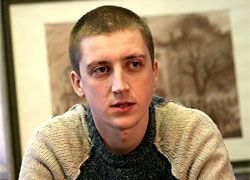
“European issue is topical for Belarus more than ever. Today more then a half of the Belarus’ population stand for Belarus’ joining the EU,” former political prisoner Artur Finkevich, Young Front activist, said in the interview to Radio Svaboda. Artur was invited to Prague for One World-2008, the 10th international documentary films festival.
– Artur, it has passed a month on Wednesday since you have been released from the Mahilou pretrial prison. Is this your first trip abroad after the release?
– Yes, I’m the first time abroad.
– Were you afraid you are in the list of the restricted to travel abroad?
– I think I’m included into this list. That is why I went through Russia: I went to Moscow by train, I went by a plane from Sheremetyevo.
– Artur, are you first time in Prague? What is your impression of the city?
– Yes, I’m the first time in Prague. I have an absolutely positive impression of the city – it’s a historical center of the Central Europe. Francysk Skaryna published his first book here. I was going to walk to the place where Skaryna was printing books, but, unfortunately, I just have had no time today.
– Artur Finkevich was a participant of the Dissents and Freedom conference, held in the frames of the One World human rights festival. Artur, what did you speak at the conference?
– I spoke about criminal persecution of youth activists, about press conference of youth leaders, representatives of public organisation, including the Young Front, held in Minsk. It was announced at the conference that we would take active part in the civil campaign “European Belarus.”
I spoke that the European issue is topical more than ever for Belarus. Today more than a half of Belarus’ population stand for Belarus’ joining the EU, at the same time it is spoken all the time about possible referendum for adoption the constitutional act with Russia. That is why we need to conduct pro-Western, pro-European campaign, so it is “European Belarus” that should respond to “integration” steps made by Russia. We are going to collect votes for the European way for Belarus: we have an intention to collect about half a million votes. We are to promote the theme of the European Union among Belarusians, we will spread materials of the campaign, in particular spread the information about 12 proposals of the European Commission to the Belarusian authorities. We will also inform about political prisoners in our country.
– Did you draw parallels between the Belarusian situation and the situations in Burma or Cuba, for example?
– Well, the situations in these countries differ from the Belarusian one. I think, unlike these countries the situation at ours will change far sooner. We, as I think, will soon live in a free country with a normal civilised president, live in a free European family. Everyone just must take a resolute step.
– Artur, you were released a month ago, after two years of restriction of liberty, and then imprisonment. What did impress you most during this first moth at large?
– Maybe it was the fact that the Belarusian society has changed in these two years. I am sure, the society has become more democratic and more people are not satisfied with the policy of the authorities. There have apparently become more displeased people, after many people lost their social privileges. In my view, Lukashenka’s rating is no more than 25-30 per cent now...
– Your associate Zmitser Khvedaruk had his 20th birthday on 5 March. What would you like to wish him?
– I’d like to wish Zmitser health, happiness, every success in his endeavours. I’d like to wish him strength, physical and spiritual, and the rest will be all right.
– Artur, I know, you want to visit Alyaksei Shydlouski, who had asked for political asylum in the Czech Republic. You in turn were proposed to leave Belarus. What is your attitude towards the political emigration?
– Every case is unique. It is absolutely wrong to judge or accuse a person, when he or she emigrates: every person has a right to have such a possibility. Everyone should sacrifice what he or she can sacrifice.
If consider the case of Alyaksei, who faced 8 -9 years of imprisonment, I support his decision to leave the country. I think he will be more useful here than in prison.
I’d like to visit him – he is somewhere near Brno. I don’t know if I will manage to find some time. In any case I’ll try to phone to him.
– We have an opportunity to listen to views of Vaclav Havel, he shared when opening the Prague Dissents and Freedom conference on 5 March. Havel suggested to think of why people become dissents and how hard and unpredictable can their destiny be:
– I think, a dissent is not a profession chosen by a person at a certain stage of life. An ordinary citizen, living an ordinary life, can’t decide all of a sudden: I’ll be a dissent from tomorrow. It can’t happen so. You just decide to do what you find more correct, honest than other things – it is a civil choice. But this choice, this decision orients you in a certain direction, and soon you are facing another, more serious dilemma: live in harmony with yourself, with your conscience, have feeling you are faithful to your beliefs, or choose to adapt to the situation, do what others do. But if a person has made the first step, and then second, third, he or she will learn some day that he is called a dissent.
My experience, experience of my friends from Charter 77 and other independent initiatives that fought for human rights, has carried an important conclusion. It is that one can’t rely on fast success. It may happen that Don Quixote endeavours, laughed out by everyone, will turn into a happy end. But it may also happen there will be no happy end, that suffering and grieve will continue, and persectuion will become more severe.”
Vaclav Havel is one of the examples of that variant of development, when a dissent comes to power. When Czechoslovakia was a communistic country, playwright Havel was one of the initiators of Charter 77. He got 4 years in prison for that. After the 1989 Velvet Revolution Havel became president of Czechoslovakia, and later he was president of the Czech Republic two terms. Havel has always expressed solidarity with democratic forces of Belarus, raised Belarusian issue in his publications and speeches. Artur what is your attitude towards Vaclav Havel?
– Frankly speaking, it is an example of a European president, who came to power by means of peope’s protest. He is a man who has always supported democratic forces in Belarus, met with its representatives and helped a number of Belarusian dissents.
– Artur, your mother worried a lot when you were behind bars. Did she support at first your active public position? Was she against it?
– Of course, any mother worries about her son, her child. Did my mother support me at first? I think so. She has always support me in all my endeavours.