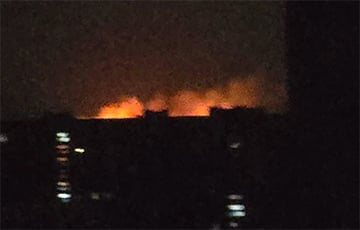


A Black Mark On The Door Of Lukashenko's Residence
4- 28.10.2026, 12:14
- 2,902
The dictator does not trust his army.
Belarusian journalist and former political prisoner Igor Karney wrote in a column for Radio Free Europe/Radio Liberty, reflected on the prospects of the Belarusian army joining the war against Ukraine:
— Recently, Ukraine’s civilian population has been suffering the most from ballistic missile attacks: taking advantage of Ukraine’s lack of air defense capabilities, the Russians are striking almost indiscriminately and at any time of day. Ukrainian intelligence does not rule out that the situation could worsen: The Kremlin is persistently pressuring Lukashenko to “lease” border areas in the Brest and Gomel regions for missile launches.
Under the guise of the “Allied Resolve-2022” exercises—after which the Russian army marched through the kindly opened gates toward Kyiv—Belarus received several dozen launchers: “Iskanders,” “Tochka-U” missiles, S-300 and S-400 air defense systems, and other equipment. In fact, these were initially used to strike northern regions of Ukraine, all the way up to Kyiv. Only increasingly credible threats of a “retaliatory strike” against military training grounds and airfields forced them to halt this practice.
However, according to information from colleagues at the “Schemes” project, the military is frantically modernizing the remaining infrastructure. The ultimate goal is to be able to strike Ukraine’s western regions as well. Since we’re talking about a minimum range of 400–500 kilometers, this poses yet another deadly threat to city residents: the air raid siren will sound virtually at the same time as the explosions.
However, as the journalist points out, this is still a theoretical scenario:
— Since the rhetoric of the Ukrainian leadership has become incomparably harsher than at the start of the aggression, the Belarusian authorities will have to think twice—and more than once—before following Moscow’s lead.
All the more so because a warning sign was planted at the doorstep of Lukashenko’s residence even earlier. The repeaters that Belarus is providing to the Russian armed forces have become a real headache for the Ukrainian Armed Forces. These stations, installed primarily on cell towers, serve as the “eyes” of drones, helping them reach their designated targets on Ukrainian territory. The Belarusian infrastructure was utilized to the fullest after the Russians lost access to American Starlink satellites, and their own alternative, “Rassvet,” remains a pipe dream.
President Zelenskyy’s summer ultimatum to Minsk—to physically jam the signal amplifiers—had only a short-lived effect; however, the devices began operating again in the fall. Apparently, pressure from Moscow proved stronger than the fear of punishment. For now, the Ukrainian side is mainly using jammers, since any other solution—as in the case of ballistic missiles—would be quite radical: the forced “elimination” of the subject of the dispute. True, again, this carries the risk of dragging the Belarusian army into the conflict. And Ukraine has no need for a second front.
Besides, Lukashenko is hardly thrilled by such a prospect. His army is small (only 50,000 troops) and consists mostly of conscripts. How they would behave on the battlefield remains to be seen. Ukrainians have never been enemies of Belarusians. Consequently, their collective motivation is practically zero.

Bank's name: Bank Millennium S.A.
Address: ul. Stanislawa Zaryna, 2A, 02-593, Warszawa
IBAN: PL97116022020000000216711123
SWIFT: BIGBPLPW
Name of the account holder: Fundacja “KARTA ‘97”
Purpose/title of payment: Donation for statuary aims
You can contact us by the e-mail charter97@gmail.com