

"Where Is Lukashenko Rushing Off To?"
1- 6.11.2026, 16:54
- 2,174

What's wrong with the opening of the new hospital in Minsk?
Analyst Sergey Chaly spoke about the recent opening of a new infectious diseases hospital in Minsk. His comments were quoted by “Solidarnast”.
— Pertsov and Eismont recently discussed COVID-19. They said that whoever was meant to get sick and be infected did just that. What do you think of the approach of “the world’s most effective fighter against COVID-19”: that whoever is destined to die will die? — asks Sergei Chaly on the “Belsat” program. — That’s Darwinism for you. But at least they didn’t shut down the economy. How disgusting that sounds.
An infectious disease hospital recently opened in Minsk. Lukashenko attended the opening. In his speech, he described how the hospital is set up: independent units, any of which can be completely isolated at any time, and in the event of a new epidemic, the hospital’s capacity can be doubled. The president calls this approach “learning lessons from the recent pandemic.”
— Let’s take a look at the hospital’s floor plan. It includes a sanitary barrier and isolated modules (four ward buildings) arranged so that patients can only enter from the street, while medical staff access the interior via corridors. Energy independence is provided for: its own heat supply and a boiler room—meaning the hospital isn’t even dependent on the city’s heating networks. It also has its own utility block, which is equipped to dispose of biological materials. In other words, neither equipment, nor gowns, nor other materials leave the perimeter.
It is also evident that the wards can easily accommodate a couple more beds. This means the hospital was originally designed with the flexibility to increase capacity. Transportation logistics have also been carefully planned—there is direct access from the facility to the Moscow Ring Road (MKAD).
And most importantly—the perimeter fence. A continuous, paved ring road runs around the entire perimeter for patrolling, and a checkpoint is located at the entrance. Armed security posts allow for the immediate blocking of entry to and exit from the premises.
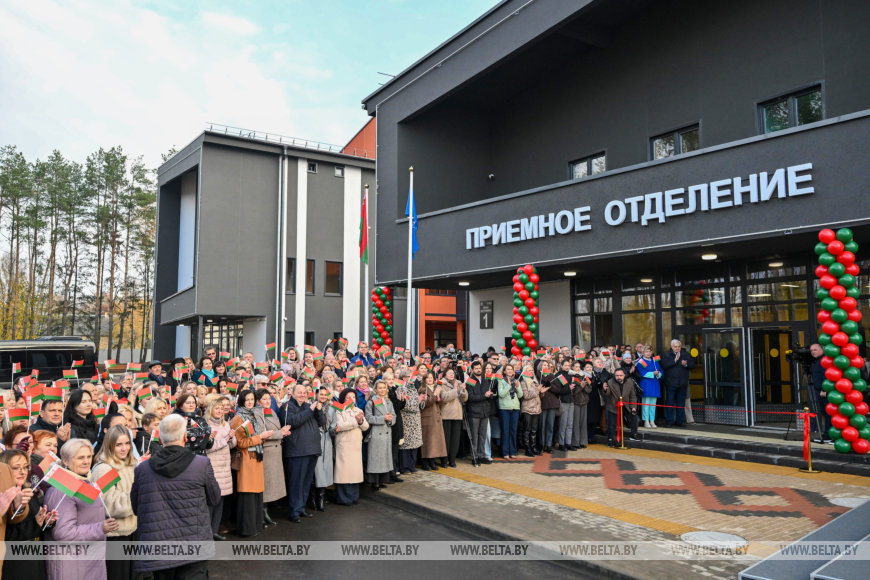
Pertsov says this facility was built in 20 months. That’s a record-breaking timeline. Usually, such facilities take about five years to build. He then brings up the pandemic again and explains that Belarus studied Russia’s experience—“the modular hospitals built by the Ministry of Defense.” He notes that Belarus now has this technology as well.
And now I want to ask: where are you rushing off to? What happened? What pandemic are you preparing for? The previous one ended long ago. Lukashenko is the “world champion” in how he handled it. So what happened?
I’ll tell you a story that was shared with me by someone who attended a meeting with Lukashenko at the very beginning of the pandemic. As soon as the first COVID-19 patients appeared, he gathered medical professionals. He seated civilian doctors to his right and military doctors to his left.
According to this person, the civilian doctors said this was an incomprehensible, unknown infection—not a matter of “who will survive and who won’t.” They explained that quarantine, mask mandates, and social distancing were necessary. But Lukashenko didn’t want any of that.
He thought he’d seat the military medics next to them and spark a debate. But they said they were prepared for such a situation. They still had protocols in place from the Cold War era for dealing with biological warfare. They proposed building a separate temporary hospital with isolation wards, each of which would have two entrances. And when it was all over—to destroy the facility along with everything inside it.
Lukashenko refused to go along with this. According to some estimates, about 90,000 people died in Belarus over the course of several waves of the pandemic. And now look at what he’s doing—exactly what he should have done back then. But to what end? And why now, of all times?
I’ll also note that after 2022, when our hospitals were filled with Russian military personnel, this experience radically changed the combined group of forces’ approach to logistical support.
Recently, the “Echelon” exercises were held, during which the evacuation of the wounded and the organization of a hospital base at the front and in the rear were practiced. During these exercises, the seriously wounded were evacuated by medical aircraft and evacuation trains and sent to special military hospitals.
In other words, roughly speaking, this hospital can instantly be converted into a facility of this kind. In other words, it’s not just for a pandemic.

Bank's name: Bank Millennium S.A.
Address: ul. Stanislawa Zaryna, 2A, 02-593, Warszawa
IBAN: PL97116022020000000216711123
SWIFT: BIGBPLPW
Name of the account holder: Fundacja “KARTA ‘97”
Purpose/title of payment: Donation for statuary aims
You can contact us by the e-mail charter97@gmail.com